

Penguin Publishing Group
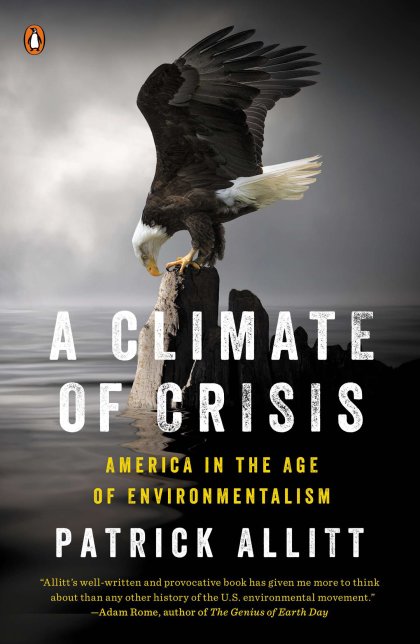
A Climate of Crisis
A Climate of Crisis
Couldn't load pickup availability
Collapsible content
ABOUT
Few issues today excite more passion or alarm than the specter of climate change. In A Climate of Crisis, historian Patrick Allitt shows that our present climate of crisis is far from exceptional. Indeed, the environmental debates of the last half century are defined by exaggeration and fearmongering from all sides, often at the expense of the facts.
In a real sense, Allitt shows us, collective anxiety about widespread environmental danger began with the atomic bomb. As postwar suburbanization transformed the American landscape, more research and better tools for measurement began to reveal the consequences of economic success. A climate of anxiety became a climate of alarm, often at odds with reality. The sixties generation transformed environmentalism from a set of special interests into a mass movement. By the first Earth Day in 1970, journalists and politicians alike were urging major initiatives to remedy environmental harm. In fact, the work of the new Environmental Protection Agency and a series of clean air and water acts from a responsive Congress inaugurated a largely successful cleanup.
Political polarization around environmental questions after 1980 had consequences that we still feel today. Since then, the general polarization of American politics has mirrored that of environmental politics, as pro-environmentalists and their critics attribute to one another the worst possible motives. Environmentalists see their critics as greedy special interest groups that show no conscience as they plunder the earth while skeptics see their adversaries as enemies of economic growth whose plans stifle initiative under an avalanche of bureaucratic regulation.
There may be a germ of truth in both views, but more than a germ of falsehood too. America’s worst environmental problems have proven to be manageable; the regulations and cleanups of the last sixty years have often worked, and science and technology have continued to improve industrial efficiency. Our present situation is serious, argues Allitt, but it is far from hopeless. Sweeping and provocative, A Climate of Crisis challenges our basic assumptions about the environment, no matter where we fall along the spectrum—reminding us that the answers to our most pressing questions are sometimes found in understanding the past.
STANDARD, PRIMARY, DM AND VARIANT COVERS
Standard and Primary covers are widely available through general retailers. They often have higher print runs and can be cheaper, especially during sales.
In contrast, Direct Market (DM) and variant covers are primarily sold in comic shops. DM editions tend to have more limited availability and may be more valuable to collectors.
The main differences lie in artwork style, availability, price, and collector appeal. Ultimately, the choice between standard and variant covers depends on personal preference, budget, and individual collecting goals.
PRODUCT TYPES
Comic book enthusiasts have various formats to choose from when collecting their favorite stories.
Here's a brief overview of the main types:
Omnibus
- Large, hardcover collections
- Usually contain complete runs or extensive story arcs
- Typically 800-1000+ pages
- Higher price point, often €100-€150
Oversized Hardcover (OHC)
- Similar dimensions to omnibus, but thinner
- Collect shorter runs or story arcs
- Usually 300-600 pages
- Priced between €30-€50
Hardcover (HC)
- Standard-sized hardcover books
- Collect 6-12 issues typically
- Similar dimensions to single issues, but with a hard cover
- Priced around €25-€35
Trade Paperback (TP)
- Softcover collections
- Standard comic book size
- Usually collect 4-6 issues
- Most affordable option, typically €15-€25
Other Formats
- Absolute Editions: Oversized, deluxe hardcovers (mainly DC Comics)
- Compendiums: Massive paperback collections
- Graphic Novels (OGN/GN): Original stories not previously released as single issues
The choice between these formats often depends on personal preference, budget, and collecting goals. Omnibus and OHC editions offer larger artwork and more content but at a higher price, while TPs provide a more affordable way to collect complete story arcs