

Penguin Publishing Group
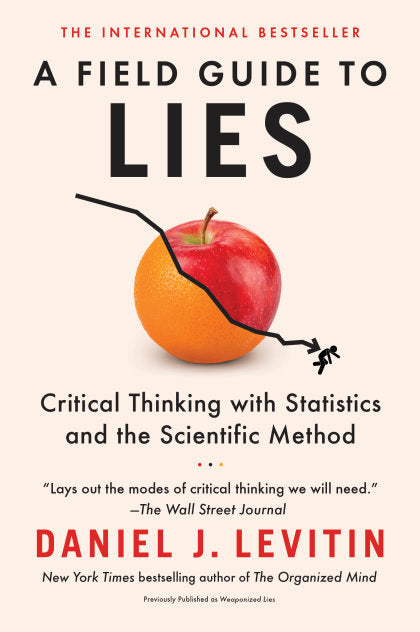
A Field Guide to Lies
A Field Guide to Lies
Couldn't load pickup availability
Collapsible content
ABOUT
From the New York Times bestselling author of The Organized Mind and This Is Your Brain on Music, a primer to the critical thinking that is more necessary now than ever
We are bombarded with more information each day than our brains can process—especially in election season. It's raining bad data, half-truths, and even outright lies. New York Times bestselling author Daniel J. Levitin shows how to recognize misleading announcements, statistics, graphs, and written reports, revealing the ways lying weasels can use them.
It's becoming harder to separate the wheat from the digital chaff. How do we distinguish misinformation, pseudo-facts, and distortions from reliable information? Levitin groups his field guide into two categories—statistical information and faulty arguments—ultimately showing how science is the bedrock of critical thinking. Infoliteracy means understanding that there are hierarchies of source quality and bias that variously distort our information feeds via every media channel, including social media. We may expect newspapers, bloggers, the government, and Wikipedia to be factually and logically correct, but they so often aren't. We need to think critically about the words and numbers we encounter if we want to be successful at work, at play, and in making the most of our lives. This means checking the plausibility and reasoning—not passively accepting information, repeating it, and making decisions based on it. Readers learn to avoid the extremes of passive gullibility and cynical rejection. Levitin's charming, entertaining, accessible guide can help anyone wake up to a whole lot of things that aren't so. And catch some weasels in their tracks!
STANDARD, PRIMARY, DM AND VARIANT COVERS
Standard and Primary covers are widely available through general retailers. They often have higher print runs and can be cheaper, especially during sales.
In contrast, Direct Market (DM) and variant covers are primarily sold in comic shops. DM editions tend to have more limited availability and may be more valuable to collectors.
The main differences lie in artwork style, availability, price, and collector appeal. Ultimately, the choice between standard and variant covers depends on personal preference, budget, and individual collecting goals.
PRODUCT TYPES
Comic book enthusiasts have various formats to choose from when collecting their favorite stories.
Here's a brief overview of the main types:
Omnibus
- Large, hardcover collections
- Usually contain complete runs or extensive story arcs
- Typically 800-1000+ pages
- Higher price point, often €100-€150
Oversized Hardcover (OHC)
- Similar dimensions to omnibus, but thinner
- Collect shorter runs or story arcs
- Usually 300-600 pages
- Priced between €30-€50
Hardcover (HC)
- Standard-sized hardcover books
- Collect 6-12 issues typically
- Similar dimensions to single issues, but with a hard cover
- Priced around €25-€35
Trade Paperback (TP)
- Softcover collections
- Standard comic book size
- Usually collect 4-6 issues
- Most affordable option, typically €15-€25
Other Formats
- Absolute Editions: Oversized, deluxe hardcovers (mainly DC Comics)
- Compendiums: Massive paperback collections
- Graphic Novels (OGN/GN): Original stories not previously released as single issues
The choice between these formats often depends on personal preference, budget, and collecting goals. Omnibus and OHC editions offer larger artwork and more content but at a higher price, while TPs provide a more affordable way to collect complete story arcs