

Harmony/Rodale/Convergent
A Terrible Strength
A Terrible Strength
Couldn't load pickup availability
Collapsible content
ABOUT
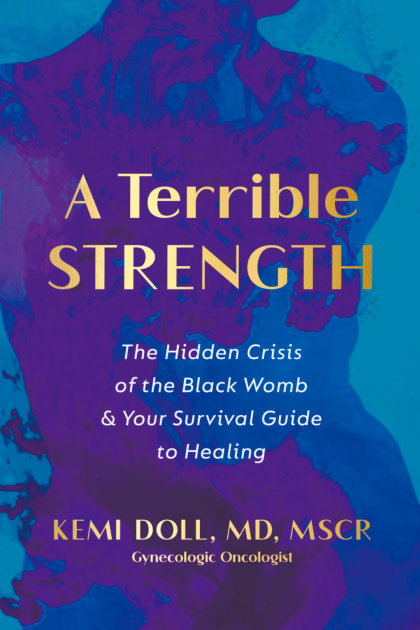
When Dr. Kemi Doll first began training to be a gynecologic cancer surgeon, she quickly noticed that the level of care being offered to women was rarely equal. She started to ask herself: Whose pain was believed? Who was “high maintenance” vs. “angry and non-compliant”? Who died? White women’s pain was doubted, but Black women’s pain was often outright denied. And the locus of this crisis was the womb. Day by day, fibroids, bleeding, inflammation, and cancer struck Black women the hardest, yet the medical field cared very little about their fate. When student physicians would explicitly bring up these alarming disparities, Dr. Doll's teachers would reply: “Black women just don’t do well with this,” followed by, “We don’t really know why.”
Since then, Dr. Doll has made it her goal to give Black women the tools they need to unlearn what she calls “womb suffering.” For all women navigating gynecologic care, and the medical professionals who care for them, this comprehensive, authoritative book of science-backed information and lived experience covers:
• The mechanisms behind the four primary conditions that affect the womb—often with fatal consequences—including Endometriosis, Fibroids, Heavy Bleeding, and Endometrial cancer.
• An overview of the research conducted on reproductive health outside pregnancy—the lack of which has caused healthcare inequity and obstructed access to care
• Gripping stories of smart, successful women struggling with and overcoming Womb Suffering
• What good gynecologic health looks like and why it is vital to reclaiming a full, healthy life; how to feel and respond to your body’s signals; and the tools and vocabulary needed to help advocate and prepare for medical visits.
A Terrible Strength links women’s health care to timely conversations on racial justice and healthcare inequity, arming women with the power to secure vibrant health and well-being for the rest of their lives.
STANDARD, PRIMARY, DM AND VARIANT COVERS
Standard and Primary covers are widely available through general retailers. They often have higher print runs and can be cheaper, especially during sales.
In contrast, Direct Market (DM) and variant covers are primarily sold in comic shops. DM editions tend to have more limited availability and may be more valuable to collectors.
The main differences lie in artwork style, availability, price, and collector appeal. Ultimately, the choice between standard and variant covers depends on personal preference, budget, and individual collecting goals.
PRODUCT TYPES
Comic book enthusiasts have various formats to choose from when collecting their favorite stories.
Here's a brief overview of the main types:
Omnibus
- Large, hardcover collections
- Usually contain complete runs or extensive story arcs
- Typically 800-1000+ pages
- Higher price point, often €100-€150
Oversized Hardcover (OHC)
- Similar dimensions to omnibus, but thinner
- Collect shorter runs or story arcs
- Usually 300-600 pages
- Priced between €30-€50
Hardcover (HC)
- Standard-sized hardcover books
- Collect 6-12 issues typically
- Similar dimensions to single issues, but with a hard cover
- Priced around €25-€35
Trade Paperback (TP)
- Softcover collections
- Standard comic book size
- Usually collect 4-6 issues
- Most affordable option, typically €15-€25
Other Formats
- Absolute Editions: Oversized, deluxe hardcovers (mainly DC Comics)
- Compendiums: Massive paperback collections
- Graphic Novels (OGN/GN): Original stories not previously released as single issues
The choice between these formats often depends on personal preference, budget, and collecting goals. Omnibus and OHC editions offer larger artwork and more content but at a higher price, while TPs provide a more affordable way to collect complete story arcs