

Random House Publishing Group
A Widow for One Year
A Widow for One Year
Couldn't load pickup availability
Collapsible content
ABOUT
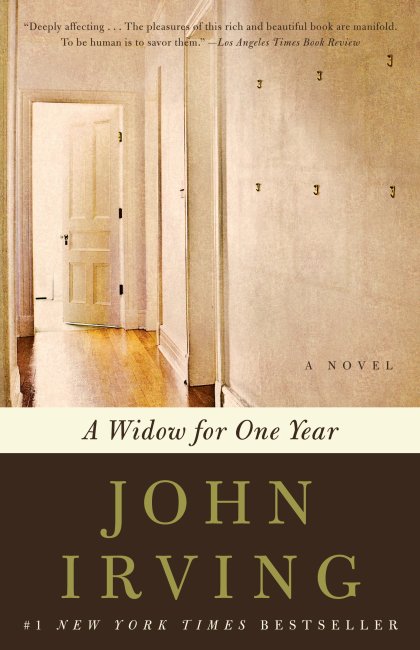
In A Widow for One Year, we follow Ruth Cole through three of the most pivotal times in her life: from her girlhood on Long Island (in the summer of 1958) through the fall of 1990 (when she is an unmarried woman whose personal life is not nearly as successful as her literary career), and at last in the autumn of 1995, when Ruth is a forty-one-year-old widow and mother (and she’s about to fall in love for the first time). Both elegiac and sensual, A Widow for One Year is a multilayered love story of astonishing emotional force.
Praise for A Widow for One Year
“Compelling . . . By turns antic and moving, lusty and tragic, A Widow for One Year is bursting with memorable moments. . . . A testament to one of life’s most difficult lessons: In the end, you just have to find a way to keep going.”—San Francisco Examiner-Chronicle
“A sprawling 19th-century production, chock full of bizarre coincidences, multiple plot lines, lengthy digressions, and stories within stories. . . . An engaging and often affecting fable, a fairy tale that manages to be old-fashioned and modern all at once.”—The New York Times
“[Irving’s] characters can beguile us onto thin ice and persuade us to dance there. His instinctive mark is the moral choice stripped bare, and his aim is impressive. What’s more, there’s hardly a writer alive who can match his control of the omniscient point of view.”—The Washington Post Book World
“In the sprawling, deeply felt A Widow for One Year, John Irving has delivered his best novel since The World According to Garp. . . . Like a warm bath, it’s a great pleasure to immerse yourself in.”—Entertainment Weekly
“John Irving is arguably the American Balzac, or perhaps our Dickens—a rip-roaring storyteller whose intricate plot machinery is propelled by good old-fashioned greed, foolishness and passion.”—The Nation
“Powerful . . . a masterpiece.”—St. Louis Post-Dispatch
STANDARD, PRIMARY, DM AND VARIANT COVERS
Standard and Primary covers are widely available through general retailers. They often have higher print runs and can be cheaper, especially during sales.
In contrast, Direct Market (DM) and variant covers are primarily sold in comic shops. DM editions tend to have more limited availability and may be more valuable to collectors.
The main differences lie in artwork style, availability, price, and collector appeal. Ultimately, the choice between standard and variant covers depends on personal preference, budget, and individual collecting goals.
PRODUCT TYPES
Comic book enthusiasts have various formats to choose from when collecting their favorite stories.
Here's a brief overview of the main types:
Omnibus
- Large, hardcover collections
- Usually contain complete runs or extensive story arcs
- Typically 800-1000+ pages
- Higher price point, often €100-€150
Oversized Hardcover (OHC)
- Similar dimensions to omnibus, but thinner
- Collect shorter runs or story arcs
- Usually 300-600 pages
- Priced between €30-€50
Hardcover (HC)
- Standard-sized hardcover books
- Collect 6-12 issues typically
- Similar dimensions to single issues, but with a hard cover
- Priced around €25-€35
Trade Paperback (TP)
- Softcover collections
- Standard comic book size
- Usually collect 4-6 issues
- Most affordable option, typically €15-€25
Other Formats
- Absolute Editions: Oversized, deluxe hardcovers (mainly DC Comics)
- Compendiums: Massive paperback collections
- Graphic Novels (OGN/GN): Original stories not previously released as single issues
The choice between these formats often depends on personal preference, budget, and collecting goals. Omnibus and OHC editions offer larger artwork and more content but at a higher price, while TPs provide a more affordable way to collect complete story arcs