

Penguin Publishing Group
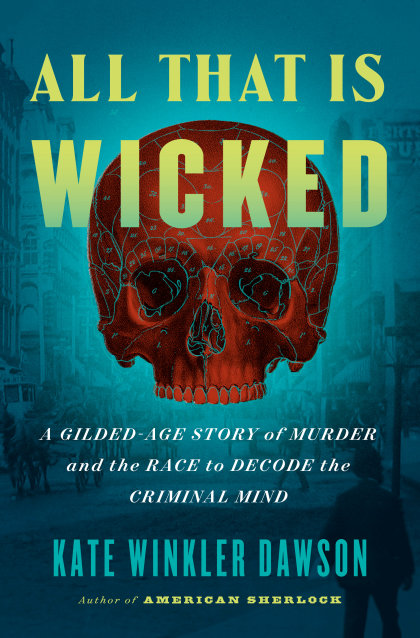
All That Is Wicked
All That Is Wicked
Couldn't load pickup availability
Collapsible content
ABOUT
Edward Rulloff was a brilliant yet utterly amoral murderer—some have called him a “Victorian-era Hannibal Lecter”—whose crimes spanned decades and whose victims were chosen out of revenge, out of envy, and sometimes out of necessity. From his humble beginnings in upstate New York to the dazzling salons and social life he established in New York City, at every turn Rulloff used his intelligence and regal bearing to evade detection and avoid punishment. He could talk his way out of any crime...until one day, Rulloff's luck ran out.
By 1871 Rulloff sat chained in his cell—a psychopath holding court while curious 19th-century "mindhunters" tried to understand what made him tick. From alienists (early psychiatrists who tried to analyze the source of his madness) to neurologists (who wanted to dissect his brain) to phrenologists (who analyzed the bumps on his head to determine his character), each one thought he held the key to understanding the essential question: is evil born or made? Eventually, Rulloff’s brain would be placed in a jar at Cornell University as the prize specimen of their anatomy collection...where it still sits today, slowly moldering in a dusty jar. But his story—and its implications for the emerging field of criminal psychology—were just beginning.
Expanded from season one of her hit podcast on the Exactly Right network (7 million downloads and growing), in All That Is Wicked Kate Winkler Dawson draws on hundreds of source materials and never-before-shared historical documents to present one of the first glimpses into the mind of a serial killer—a century before the term was coined—through the scientists whose work would come to influence criminal justice for decades to come.
STANDARD, PRIMARY, DM AND VARIANT COVERS
Standard and Primary covers are widely available through general retailers. They often have higher print runs and can be cheaper, especially during sales.
In contrast, Direct Market (DM) and variant covers are primarily sold in comic shops. DM editions tend to have more limited availability and may be more valuable to collectors.
The main differences lie in artwork style, availability, price, and collector appeal. Ultimately, the choice between standard and variant covers depends on personal preference, budget, and individual collecting goals.
PRODUCT TYPES
Comic book enthusiasts have various formats to choose from when collecting their favorite stories.
Here's a brief overview of the main types:
Omnibus
- Large, hardcover collections
- Usually contain complete runs or extensive story arcs
- Typically 800-1000+ pages
- Higher price point, often €100-€150
Oversized Hardcover (OHC)
- Similar dimensions to omnibus, but thinner
- Collect shorter runs or story arcs
- Usually 300-600 pages
- Priced between €30-€50
Hardcover (HC)
- Standard-sized hardcover books
- Collect 6-12 issues typically
- Similar dimensions to single issues, but with a hard cover
- Priced around €25-€35
Trade Paperback (TP)
- Softcover collections
- Standard comic book size
- Usually collect 4-6 issues
- Most affordable option, typically €15-€25
Other Formats
- Absolute Editions: Oversized, deluxe hardcovers (mainly DC Comics)
- Compendiums: Massive paperback collections
- Graphic Novels (OGN/GN): Original stories not previously released as single issues
The choice between these formats often depends on personal preference, budget, and collecting goals. Omnibus and OHC editions offer larger artwork and more content but at a higher price, while TPs provide a more affordable way to collect complete story arcs