

Penguin Publishing Group
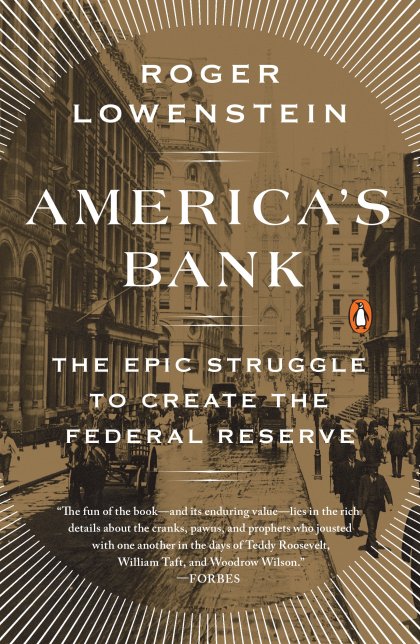
America's Bank
America's Bank
Couldn't load pickup availability
Collapsible content
ABOUT
For nearly a century, America, alone among developed nations, refused to consider any central or organizing agency in its financial system. Americans’ mistrust of big government and of big banks—a legacy of the country’s Jeffersonian, small-government traditions—was so widespread that modernizing reform was deemed impossible. Each bank was left to stand on its own, with no central reserve or lender of last resort. The real-world consequences of this chaotic and provincial system were frequent financial panics, bank runs, money shortages, and depressions. By the first decade of the twentieth century, it had become plain that the outmoded banking system was ill equipped to finance America’s burgeoning industry. But political will for reform was lacking. It took an economic meltdown, a high-level tour of Europe, and—improbably—a conspiratorial effort by vilified captains of Wall Street to overcome popular resistance. Finally, in 1913, Congress conceived a federalist and quintessentially American solution to the conflict that had divided bankers, farmers, populists, and ordinary Americans, and enacted the landmark Federal Reserve Act.
Roger Lowenstein—acclaimed financial journalist and bestselling author of When Genius Failed and The End of Wall Street—tells the drama-laden story of how America created the Federal Reserve, thereby taking its first steps onto the world stage as a global financial power. America’s Bank showcases Lowenstein at his very finest: illuminating complex financial and political issues with striking clarity, infusing the debates of our past with all the gripping immediacy of today, and painting unforgettable portraits of Gilded Age bankers, presidents, and politicians.
Lowenstein focuses on the four men at the heart of the struggle to create the Federal Reserve. These were Paul Warburg, a refined, German-born financier, recently relocated to New York, who was horrified by the primitive condition of America’s finances; Rhode Island’s Nelson W. Aldrich, the reigning power broker in the U.S. Senate and an archetypal Gilded Age legislator; Carter Glass, the ambitious, if then little-known, Virginia congressman who chaired the House Banking Committee at a crucial moment of political transition; and President Woodrow Wilson, the academician-turned-progressive-politician who forced Glass to reconcile his deep-seated differences with bankers and accept the principle (anathema to southern Democrats) of federal control. Weaving together a raucous era in American politics with a storied financial crisis and intrigue at the highest levels of Washington and Wall Street, Lowenstein brings the beginnings of one of the country’s most crucial institutions to vivid and unforgettable life. Readers of this gripping historical narrative will wonder whether they’re reading about one hundred years ago or the still-seething conflicts that mark our discussions of banking and politics today.
STANDARD, PRIMARY, DM AND VARIANT COVERS
Standard and Primary covers are widely available through general retailers. They often have higher print runs and can be cheaper, especially during sales.
In contrast, Direct Market (DM) and variant covers are primarily sold in comic shops. DM editions tend to have more limited availability and may be more valuable to collectors.
The main differences lie in artwork style, availability, price, and collector appeal. Ultimately, the choice between standard and variant covers depends on personal preference, budget, and individual collecting goals.
PRODUCT TYPES
Comic book enthusiasts have various formats to choose from when collecting their favorite stories.
Here's a brief overview of the main types:
Omnibus
- Large, hardcover collections
- Usually contain complete runs or extensive story arcs
- Typically 800-1000+ pages
- Higher price point, often €100-€150
Oversized Hardcover (OHC)
- Similar dimensions to omnibus, but thinner
- Collect shorter runs or story arcs
- Usually 300-600 pages
- Priced between €30-€50
Hardcover (HC)
- Standard-sized hardcover books
- Collect 6-12 issues typically
- Similar dimensions to single issues, but with a hard cover
- Priced around €25-€35
Trade Paperback (TP)
- Softcover collections
- Standard comic book size
- Usually collect 4-6 issues
- Most affordable option, typically €15-€25
Other Formats
- Absolute Editions: Oversized, deluxe hardcovers (mainly DC Comics)
- Compendiums: Massive paperback collections
- Graphic Novels (OGN/GN): Original stories not previously released as single issues
The choice between these formats often depends on personal preference, budget, and collecting goals. Omnibus and OHC editions offer larger artwork and more content but at a higher price, while TPs provide a more affordable way to collect complete story arcs