

Kensington
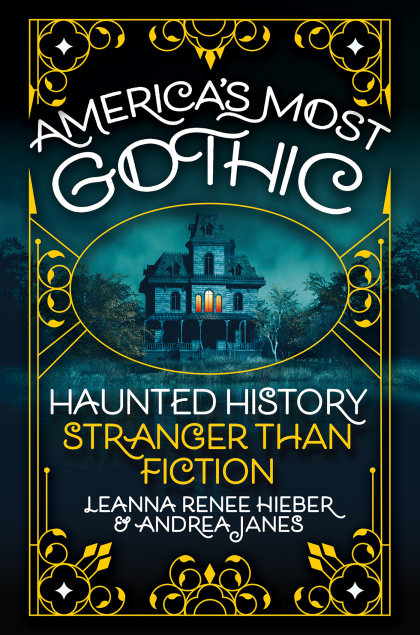
America’s Most Gothic
America’s Most Gothic
Couldn't load pickup availability
Collapsible content
ABOUT
From the Bram Stoker nominated author team who penned A Haunted History of Invisible Women, the first book of its kind to investigate gothic tropes that define American lore. Here is the hidden, dark history of what frightens us - and why.
The Gothic. Brooding, atmospheric, chilling, and not always the outpouring of a feverish imagination. Reality can be even stranger as borne out in this lush and ghostly look at real people who lived--and died—amidst the trappings of the Gothic.
Fog clinging to an isolated mansion. A dangerous patriarch or an overbearing matron. Locked doors and forbidden rooms. Whispers of murder and madness. And a woman shadowed by omnipresent threats. You’ve guessed it. You’ve stumbled into a Gothic tale, and it will haunt you like a ghost.
We often think of the enduring tropes of the Gothic in terms of fiction and film—breath-catching escapes that tap into our fears, anxieties, forbidden desires, and unsettling dreams. But what if some of these chilly vibes are rooted in the experiences of real and tragic people who danced a macabre waltz with love and death? That’s why we’re here. Take the case of teenage Mercy Brown, victim—or was it predator?—of Rhode Island’s vampire hysteria of the 1890s. Marguerite de la Roque, a French noblewoman condemned for “sexual crimes” to Canada’s long-lost Isle of Demons. What happened to her and the barren landscape itself is the stuff of legend. And “Mad Lucy” Ludwell, the decidedly peculiar eighteenth-century high-society hauteur driven mad in the Virginia estate she prowls to this day. President Helen Peabody’s spirit still stringently watches over her Women’s College, now part of Ohio’s Miami University. Ghosts of workers lost in horrific conditions while building the Hoosac Tunnel warn of imminent danger. Settle in. There are more.
Welcome to the phantom ships, haunted academic halls, menacing landscapes, and family curses of America’s Most Gothic—a tour of true spectral sightings and disordered minds. But beware: it’s sure to get under your skin. The haunted—and haunting—figures herein want it that way.
STANDARD, PRIMARY, DM AND VARIANT COVERS
Standard and Primary covers are widely available through general retailers. They often have higher print runs and can be cheaper, especially during sales.
In contrast, Direct Market (DM) and variant covers are primarily sold in comic shops. DM editions tend to have more limited availability and may be more valuable to collectors.
The main differences lie in artwork style, availability, price, and collector appeal. Ultimately, the choice between standard and variant covers depends on personal preference, budget, and individual collecting goals.
PRODUCT TYPES
Comic book enthusiasts have various formats to choose from when collecting their favorite stories.
Here's a brief overview of the main types:
Omnibus
- Large, hardcover collections
- Usually contain complete runs or extensive story arcs
- Typically 800-1000+ pages
- Higher price point, often €100-€150
Oversized Hardcover (OHC)
- Similar dimensions to omnibus, but thinner
- Collect shorter runs or story arcs
- Usually 300-600 pages
- Priced between €30-€50
Hardcover (HC)
- Standard-sized hardcover books
- Collect 6-12 issues typically
- Similar dimensions to single issues, but with a hard cover
- Priced around €25-€35
Trade Paperback (TP)
- Softcover collections
- Standard comic book size
- Usually collect 4-6 issues
- Most affordable option, typically €15-€25
Other Formats
- Absolute Editions: Oversized, deluxe hardcovers (mainly DC Comics)
- Compendiums: Massive paperback collections
- Graphic Novels (OGN/GN): Original stories not previously released as single issues
The choice between these formats often depends on personal preference, budget, and collecting goals. Omnibus and OHC editions offer larger artwork and more content but at a higher price, while TPs provide a more affordable way to collect complete story arcs