

Random House Publishing Group
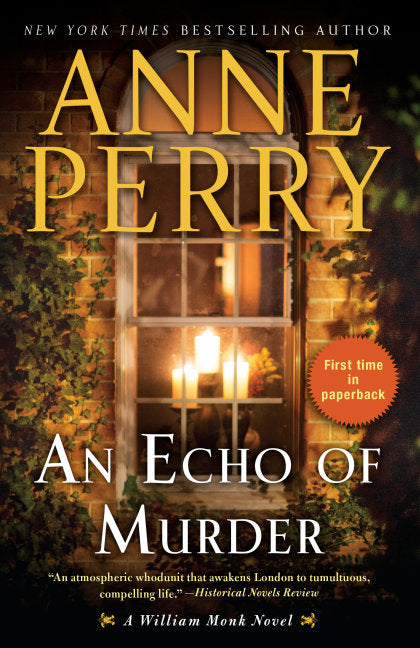
An Echo of Murder
An Echo of Murder
Couldn't load pickup availability
Collapsible content
ABOUT
In the course of his tenure with the Thames River Police, Commander Monk has yet to see a more gruesome crime scene: a Hungarian warehouse owner lies in the middle of his blood-sodden office, pierced through the chest with a bayonet and eerily surrounded by seventeen candles, their wicks dipped in blood. Suspecting the murder may be rooted in ethnic prejudice, Monk turns to London’s Hungarian community in search of clues but finds his inquiries stymied by its wary citizens and a language he doesn’t speak. Only with the help of a local pharmacist acting as translator can Monk hope to penetrate this tightly knit enclave, even as more of its members fall victim to identical brutal murders. But whoever the killer, or killers, may be—a secret society practicing ritual sacrifice, a madman on a spree, a British native targeting foreigners—they are well hidden among the city’s ever-growing populace.
With the able assistance of his wife—former battlefield nurse Hester, who herself is dealing with a traumatized war veteran who may be tangled up in the murders—Monk must combat distrust, hostility, and threats from the very people he seeks to protect. But as the body count grows, stirring ever greater fear and anger among the Hungarian émigrés, resistance to the police also increases. Racing time and the rising tide of terror all around him, Monk must be even more relentless than the mysterious killer, or the echoes of malice and murder will resound through London’s streets like a clarion of doom.
Praise for An Echo of Murder
“[Anne] Perry fashions a rich, if blood-spattered narrative from this chapter of history. As the murders [of Hungarians] continue, Monk and his clever wife, Hester . . . struggle to fathom the new climate of hatred. ‘I think it’s fear,’ Hester says. ‘It’s fear of ideas, things that aren’t the way you’re used to. Everyone you don’t understand because their language is different, their food, but above all their religion.’ How times haven’t changed.”—The New York Times Book Review
“Skillful . . . Perry smoothly intertwines themes—war’s lingering cost, tension around immigration and otherness—that challenge in both her period and our own.”—Publishers Weekly
STANDARD, PRIMARY, DM AND VARIANT COVERS
Standard and Primary covers are widely available through general retailers. They often have higher print runs and can be cheaper, especially during sales.
In contrast, Direct Market (DM) and variant covers are primarily sold in comic shops. DM editions tend to have more limited availability and may be more valuable to collectors.
The main differences lie in artwork style, availability, price, and collector appeal. Ultimately, the choice between standard and variant covers depends on personal preference, budget, and individual collecting goals.
PRODUCT TYPES
Comic book enthusiasts have various formats to choose from when collecting their favorite stories.
Here's a brief overview of the main types:
Omnibus
- Large, hardcover collections
- Usually contain complete runs or extensive story arcs
- Typically 800-1000+ pages
- Higher price point, often €100-€150
Oversized Hardcover (OHC)
- Similar dimensions to omnibus, but thinner
- Collect shorter runs or story arcs
- Usually 300-600 pages
- Priced between €30-€50
Hardcover (HC)
- Standard-sized hardcover books
- Collect 6-12 issues typically
- Similar dimensions to single issues, but with a hard cover
- Priced around €25-€35
Trade Paperback (TP)
- Softcover collections
- Standard comic book size
- Usually collect 4-6 issues
- Most affordable option, typically €15-€25
Other Formats
- Absolute Editions: Oversized, deluxe hardcovers (mainly DC Comics)
- Compendiums: Massive paperback collections
- Graphic Novels (OGN/GN): Original stories not previously released as single issues
The choice between these formats often depends on personal preference, budget, and collecting goals. Omnibus and OHC editions offer larger artwork and more content but at a higher price, while TPs provide a more affordable way to collect complete story arcs