

Harmony/Rodale/Convergent
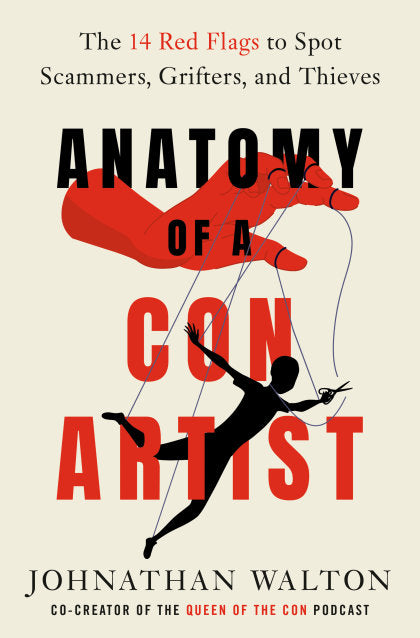
Anatomy of a Con Artist
Anatomy of a Con Artist
Couldn't load pickup availability
Collapsible content
ABOUT
“Johnathan Walton has written a master class on how to spot scammers, con artists, grifters, and thieves. And his storytelling reads like a crime novel. . . . A must-read.”—Joe Navarro, FBI special agent (ret.) and author of the international bestseller Dangerous Personalities
“Some people play golf on the weekends,” Johnathan Walton says. “I hunt con artists.”
Con artists are everywhere—your new boyfriend or girlfriend, your new neighbor or coworker, your new friend—and they don’t outsmart you; they out-feel you to get their hands on your money. In Anatomy of a Con Artist, Walton lays out “the tells” based on hundreds of real-life cases he’s investigated, including:
Red Flag #1—A Stranger Offering Help: Someone new and overly helpful insinuates themselves into your life.
Red Flag #3—Drama, Drama, Drama: Constant dramatic “emergencies” to pull you in.
Red Flag #8—Beak Wetting: Faux generosity—gifts, money, or favors to bring your guard down.
After being scammed out of nearly $100,000 by a devious con artist, Walton was turned away by police. Infuriated and armed with the investigative skills he’d gained from years as a TV reporter, Walton launched his own investigation and built a compelling criminal case authorities could not ignore. Walton got his con artist charged, prosecuted, and convicted, then devoted his life to helping other victims do the same. This book packs in all he has learned.
Some con artists scheme for money, some for attention, some just for the thrill of lying. And if you think it can’t happen to you, then you are exactly the kind of “mark” a professional con artist is looking for. With this insightful guide in your hands, you are far less likely to get conned and far more likely to spot these nefarious manipulators from a mile away—and cross the street when you see them coming.
STANDARD, PRIMARY, DM AND VARIANT COVERS
Standard and Primary covers are widely available through general retailers. They often have higher print runs and can be cheaper, especially during sales.
In contrast, Direct Market (DM) and variant covers are primarily sold in comic shops. DM editions tend to have more limited availability and may be more valuable to collectors.
The main differences lie in artwork style, availability, price, and collector appeal. Ultimately, the choice between standard and variant covers depends on personal preference, budget, and individual collecting goals.
PRODUCT TYPES
Comic book enthusiasts have various formats to choose from when collecting their favorite stories.
Here's a brief overview of the main types:
Omnibus
- Large, hardcover collections
- Usually contain complete runs or extensive story arcs
- Typically 800-1000+ pages
- Higher price point, often €100-€150
Oversized Hardcover (OHC)
- Similar dimensions to omnibus, but thinner
- Collect shorter runs or story arcs
- Usually 300-600 pages
- Priced between €30-€50
Hardcover (HC)
- Standard-sized hardcover books
- Collect 6-12 issues typically
- Similar dimensions to single issues, but with a hard cover
- Priced around €25-€35
Trade Paperback (TP)
- Softcover collections
- Standard comic book size
- Usually collect 4-6 issues
- Most affordable option, typically €15-€25
Other Formats
- Absolute Editions: Oversized, deluxe hardcovers (mainly DC Comics)
- Compendiums: Massive paperback collections
- Graphic Novels (OGN/GN): Original stories not previously released as single issues
The choice between these formats often depends on personal preference, budget, and collecting goals. Omnibus and OHC editions offer larger artwork and more content but at a higher price, while TPs provide a more affordable way to collect complete story arcs