

Penguin Publishing Group
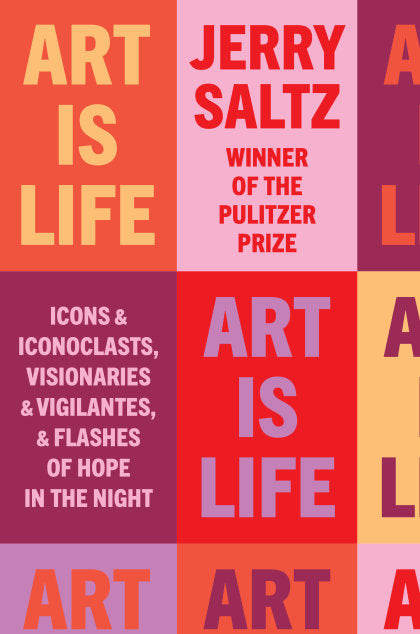
Art Is Life
Art Is Life
Couldn't load pickup availability
Collapsible content
ABOUT
Jerry Saltz is one of our most-watched writers about art and artists, and a passionate champion of the importance of art in our shared cultural life. Since the 1990s he has been an indispensable cultural voice: witty and provocative, he has attracted contemporary readers to fine art as few critics have. An early champion of forgotten and overlooked women artists, he has also celebrated the pioneering work of African American, LGBTQ+, and other long-marginalized creators. Sotheby's Institute of Art has called him, simply, “the art critic.”
Now, in Art Is Life, Jerry Saltz draws on two decades of work to offer a real-time survey of contemporary art as a barometer of our times. Chronicling a period punctuated by dramatic turning points—from the cultural reset of 9/11 to the rolling social crises of today—Saltz traces how visionary artists have both documented and challenged the culture. Art Is Life offers Saltz’s eye-opening appraisals of trailblazers like Kara Walker, David Wojnarowicz, Hilma af Klint, and Jasper Johns; provocateurs like Jeff Koons, Richard Prince, and Marina Abramović; and visionaries like Jackson Pollock, Bill Traylor, and Willem de Kooning. Saltz celebrates landmarks like the Obama portraits by Kehinde Wiley and Amy Sherald, writes searchingly about disturbing moments such as the Ankara gallery assassination, and offers surprising takes on figures from Thomas Kinkade to Kim Kardashian. And he shares stories of his own haunted childhood, his time as a “failed artist,” and his epiphanies upon beholding work by Botticelli, Delacroix, and the cave painters of Niaux.
With his signature blend of candor and conviction, Jerry Saltz argues in Art Is Life for the importance of the fearless artist—reminding us that art is a kind of channeled voice of human experience, a necessary window onto our times. The result is an openhearted and irresistibly readable appraisal by one of our most important cultural observers.
STANDARD, PRIMARY, DM AND VARIANT COVERS
Standard and Primary covers are widely available through general retailers. They often have higher print runs and can be cheaper, especially during sales.
In contrast, Direct Market (DM) and variant covers are primarily sold in comic shops. DM editions tend to have more limited availability and may be more valuable to collectors.
The main differences lie in artwork style, availability, price, and collector appeal. Ultimately, the choice between standard and variant covers depends on personal preference, budget, and individual collecting goals.
PRODUCT TYPES
Comic book enthusiasts have various formats to choose from when collecting their favorite stories.
Here's a brief overview of the main types:
Omnibus
- Large, hardcover collections
- Usually contain complete runs or extensive story arcs
- Typically 800-1000+ pages
- Higher price point, often €100-€150
Oversized Hardcover (OHC)
- Similar dimensions to omnibus, but thinner
- Collect shorter runs or story arcs
- Usually 300-600 pages
- Priced between €30-€50
Hardcover (HC)
- Standard-sized hardcover books
- Collect 6-12 issues typically
- Similar dimensions to single issues, but with a hard cover
- Priced around €25-€35
Trade Paperback (TP)
- Softcover collections
- Standard comic book size
- Usually collect 4-6 issues
- Most affordable option, typically €15-€25
Other Formats
- Absolute Editions: Oversized, deluxe hardcovers (mainly DC Comics)
- Compendiums: Massive paperback collections
- Graphic Novels (OGN/GN): Original stories not previously released as single issues
The choice between these formats often depends on personal preference, budget, and collecting goals. Omnibus and OHC editions offer larger artwork and more content but at a higher price, while TPs provide a more affordable way to collect complete story arcs