

Penguin Publishing Group
Baseless
Baseless
Couldn't load pickup availability
Collapsible content
ABOUT
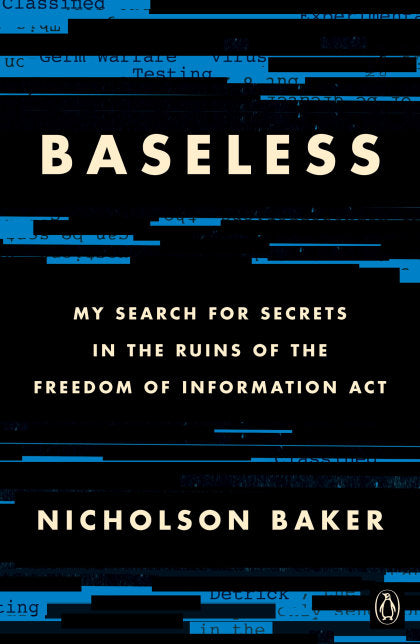
A major new work, a hybrid of history, journalism, and memoir, about the modern Freedom of Information Act—FOIA—and the horrifying, decades-old government misdeeds that it is unable to demystify, from one of America's most celebrated writers
Eight years ago, while investigating the possibility that the United States had used biological weapons in the Korean War, Nicholson Baker requested a series of Air Force documents from the early 1950s under the provisions of the Freedom of Information Act. Years went by, and he got no response. Rather than wait forever, Baker set out to keep a personal journal of what it feels like to try to write about major historical events in a world of pervasive redactions, witheld records, and glacially slow governmental responses. The result is one of the most original and daring works of nonfiction in recent memory, a singular and mesmerizing narrative that tunnels into the history of some of the darkest and most shameful plans and projects of the CIA, the Air Force, and the presidencies of Harry Truman and Dwight Eisenhower.
In his lucid and unassuming style, Baker assembles what he learns, piece by piece, about Project Baseless, a crash Pentagon program begun in the early fifties that aimed to achieve "an Air Force-wide combat capability in biological and chemical warfare at the earliest possible date." Along the way, he unearths stories of balloons carrying crop disease, leaflet bombs filled with feathers, suicidal scientists, leaky centrifuges, paranoid political-warfare tacticians, insane experiments on animals and humans, weaponized ticks, ferocious propaganda battles with China, and cover and deception plans meant to trick the Kremlin into ramping up its germ-warfare program. At the same time, Baker tells the stories of the heroic journalists and lawyers who have devoted their energies to wresting documentary evidence from government repositories, and he shares anecdotes from his daily life in Maine feeding his dogs and watching the morning light gather on the horizon. The result is an astonishing and utterly disarming story about waiting, bureaucracy, the horrors of war, and, above all, the cruel secrets that the United States government seems determined to keep forever from its citizens.
STANDARD, PRIMARY, DM AND VARIANT COVERS
Standard and Primary covers are widely available through general retailers. They often have higher print runs and can be cheaper, especially during sales.
In contrast, Direct Market (DM) and variant covers are primarily sold in comic shops. DM editions tend to have more limited availability and may be more valuable to collectors.
The main differences lie in artwork style, availability, price, and collector appeal. Ultimately, the choice between standard and variant covers depends on personal preference, budget, and individual collecting goals.
PRODUCT TYPES
Comic book enthusiasts have various formats to choose from when collecting their favorite stories.
Here's a brief overview of the main types:
Omnibus
- Large, hardcover collections
- Usually contain complete runs or extensive story arcs
- Typically 800-1000+ pages
- Higher price point, often €100-€150
Oversized Hardcover (OHC)
- Similar dimensions to omnibus, but thinner
- Collect shorter runs or story arcs
- Usually 300-600 pages
- Priced between €30-€50
Hardcover (HC)
- Standard-sized hardcover books
- Collect 6-12 issues typically
- Similar dimensions to single issues, but with a hard cover
- Priced around €25-€35
Trade Paperback (TP)
- Softcover collections
- Standard comic book size
- Usually collect 4-6 issues
- Most affordable option, typically €15-€25
Other Formats
- Absolute Editions: Oversized, deluxe hardcovers (mainly DC Comics)
- Compendiums: Massive paperback collections
- Graphic Novels (OGN/GN): Original stories not previously released as single issues
The choice between these formats often depends on personal preference, budget, and collecting goals. Omnibus and OHC editions offer larger artwork and more content but at a higher price, while TPs provide a more affordable way to collect complete story arcs