

Random House Publishing Group
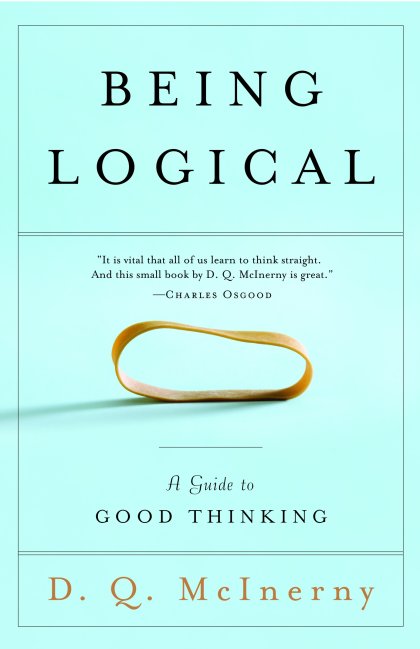
Being Logical
Being Logical
Couldn't load pickup availability
Collapsible content
ABOUT
Logic is synonymous with reason, judgment, sense, wisdom, and sanity. Being logical is the ability to create concise and reasoned arguments—arguments that build from given premises, using evidence, to a genuine conclusion. But mastering logical thinking also requires studying and understanding illogical thinking, both to sharpen one’s own skills and to protect against incoherent, or deliberately misleading, reasoning.
Elegant, pithy, and precise, Being Logical breaks logic down to its essentials through clear analysis, accessible examples, and focused insights. D. Q. McInerney covers the sources of illogical thinking, from naïve optimism to narrow-mindedness, before dissecting the various tactics—red herrings, diversions, and simplistic reasoning—the illogical use in place of effective reasoning.
An indispensable guide to using logic to advantage in everyday life, this is a concise, crisply readable book. Written explicitly for the layperson, McInerny’s Being Logical promises to take its place beside Strunk and White’s The Elements of Style as a classic of lucid, invaluable advice.
Praise for Being Logical
“Highly readable . . . D. Q. McInerny offers an introduction to symbolic logic in plain English, so you can finally be clear on what is deductive reasoning and what is inductive. And you’ll see how deductive arguments are constructed.”—Detroit Free Press
“McInerny’s explanatory outline of sound thinking will be eminently beneficial to expository writers, debaters, and public speakers.”—Booklist
“Given the shortage of logical thinking,
And the fact that mankind is adrift, if not sinking,
It is vital that all of us learn to think straight.
And this small book by D.Q. McInerny is great.
It follows therefore since we so badly need it,
Everybody should not only but it, but read it.”
—Charles Osgood
STANDARD, PRIMARY, DM AND VARIANT COVERS
Standard and Primary covers are widely available through general retailers. They often have higher print runs and can be cheaper, especially during sales.
In contrast, Direct Market (DM) and variant covers are primarily sold in comic shops. DM editions tend to have more limited availability and may be more valuable to collectors.
The main differences lie in artwork style, availability, price, and collector appeal. Ultimately, the choice between standard and variant covers depends on personal preference, budget, and individual collecting goals.
PRODUCT TYPES
Comic book enthusiasts have various formats to choose from when collecting their favorite stories.
Here's a brief overview of the main types:
Omnibus
- Large, hardcover collections
- Usually contain complete runs or extensive story arcs
- Typically 800-1000+ pages
- Higher price point, often €100-€150
Oversized Hardcover (OHC)
- Similar dimensions to omnibus, but thinner
- Collect shorter runs or story arcs
- Usually 300-600 pages
- Priced between €30-€50
Hardcover (HC)
- Standard-sized hardcover books
- Collect 6-12 issues typically
- Similar dimensions to single issues, but with a hard cover
- Priced around €25-€35
Trade Paperback (TP)
- Softcover collections
- Standard comic book size
- Usually collect 4-6 issues
- Most affordable option, typically €15-€25
Other Formats
- Absolute Editions: Oversized, deluxe hardcovers (mainly DC Comics)
- Compendiums: Massive paperback collections
- Graphic Novels (OGN/GN): Original stories not previously released as single issues
The choice between these formats often depends on personal preference, budget, and collecting goals. Omnibus and OHC editions offer larger artwork and more content but at a higher price, while TPs provide a more affordable way to collect complete story arcs