

Crown
Birdmen, Batmen, and Skyflyers
Birdmen, Batmen, and Skyflyers
Couldn't load pickup availability
Collapsible content
ABOUT
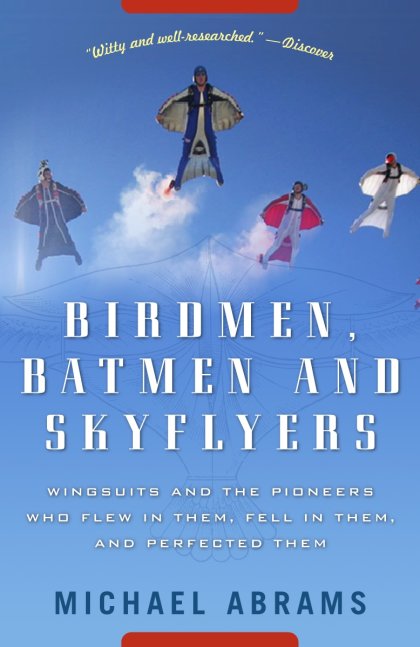
Or so you might think after reading this account of their unsung but even more daring rivals—the men and women who strapped wings to their backs and took to the sky. If only for a few seconds.
People have been dying to fly, quite literally, since the dawn of history. They’ve made wings of feather and bone, leather and wood, canvas and taffeta, and thrown themselves off the highest places they could find. Theirs is the world’s first and still most dangerous extreme sport, and its full history has never been told.
Birdmen, Batmen, and Skyflyers is a thrilling, hilarious, and often touching chronicle of these obsessive inventors and eccentric daredevils. It traces the story of winged flight from its doomed early pioneers to their glorious high-tech descendants, who’ve at last conquered gravity (sometimes, anyway). Michael Abrams gives us a brilliant bird’s-eye view of what it’s like to fly with wings. And then, inevitably, to fall.
In the Immortal Words of Great Birdmen...
“Someday I think that everyone will have wings and be able to soar from the housetops. But there must be a lot more experimenting before that can happen.” —Clem Sohn, the world’s first batman, who plummeted to his death at the Paris Air Show in 1937
“The trouble was that he went only halfway up the radio tower. If he had gone clear to the top it would have been different.” —Amadeo Catao Lopes in 1946, explaining the broken legs of the man who tried his wings
“One day, a jump will be the last. The jump of death. But that idea does not hold me back.” —Rudolf Richard Boehlen, who died of jump-related injuries in 1953
“It turned out that almost everyone from the thirties and forties had died. That just made me want to do it more.” —Garth Taggart, stunt jumper for The Gypsy Moths, filmed in 1968
“You have to be the first one. The second one is the first loser.” —Felix Baumgartner, who in 2003 became the first birdman to cross the English Channel
STANDARD, PRIMARY, DM AND VARIANT COVERS
Standard and Primary covers are widely available through general retailers. They often have higher print runs and can be cheaper, especially during sales.
In contrast, Direct Market (DM) and variant covers are primarily sold in comic shops. DM editions tend to have more limited availability and may be more valuable to collectors.
The main differences lie in artwork style, availability, price, and collector appeal. Ultimately, the choice between standard and variant covers depends on personal preference, budget, and individual collecting goals.
PRODUCT TYPES
Comic book enthusiasts have various formats to choose from when collecting their favorite stories.
Here's a brief overview of the main types:
Omnibus
- Large, hardcover collections
- Usually contain complete runs or extensive story arcs
- Typically 800-1000+ pages
- Higher price point, often €100-€150
Oversized Hardcover (OHC)
- Similar dimensions to omnibus, but thinner
- Collect shorter runs or story arcs
- Usually 300-600 pages
- Priced between €30-€50
Hardcover (HC)
- Standard-sized hardcover books
- Collect 6-12 issues typically
- Similar dimensions to single issues, but with a hard cover
- Priced around €25-€35
Trade Paperback (TP)
- Softcover collections
- Standard comic book size
- Usually collect 4-6 issues
- Most affordable option, typically €15-€25
Other Formats
- Absolute Editions: Oversized, deluxe hardcovers (mainly DC Comics)
- Compendiums: Massive paperback collections
- Graphic Novels (OGN/GN): Original stories not previously released as single issues
The choice between these formats often depends on personal preference, budget, and collecting goals. Omnibus and OHC editions offer larger artwork and more content but at a higher price, while TPs provide a more affordable way to collect complete story arcs