

Charlesbridge
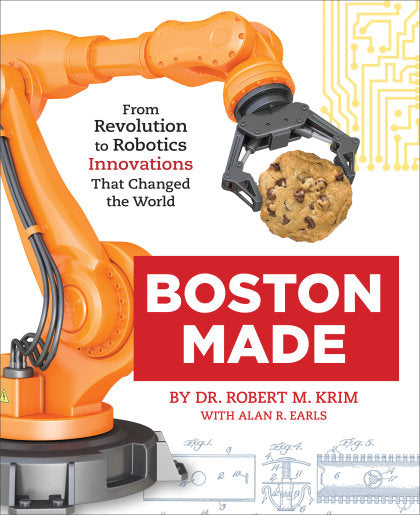
Boston Made
Boston Made
Couldn't load pickup availability
Collapsible content
ABOUT
“Robert Krim is a long-time champion of the Boston area’s history of innovation, finding remarkable examples of ingenuity and creativity going back centuries and continuing today. He shows how a culture of innovation can make a small place a beacon of hope for the world, by developing the fresh ideas and useful discoveries that make a difference in every part of life.”
—Rosabeth Moss Kanter, Harvard Business School professor and author of Think Outside the Building: How Advanced Leaders Can Change the World One Smart Innovation at a Time
Since the 1600s, Boston has been at the forefront of world-changing innovation from starting the country's first public school to becoming the first state to end slavery and giving birth to the telephone. Boston was the site of the first organ transplant and more recent medical and biotech breakthroughs that have saved the lives of thousands. That's not to mention pioneering advances in everything from rockets to robotics.
In total, Boston-area inventors have contributed more than four hundred stand-out social, scientific, and commercial innovations and uncounted numbers that are less well known. Boston Made tells the absorbing stories of 50 of these - and why they are no accident.
In fact, fresh waves of innovation have brought the city back from four major economic collapses. Dr. Robert Krim lays out a set of "innovation drivers," including strong entrepreneurship, local funding, and networking. From boom to decline and back to boom, Boston has maintained an ability to reinvent, and build anew.
Dr. Krim with technologist Alan Earls have developed and outlined a new interpretation of how a resilient city has flourished. At a time when the national and global economy is reeling from pandemic shockwaves, the authors have laid out what a dynamic world-class city has done in the face of adversity to find a fresh and successful path forward.
STANDARD, PRIMARY, DM AND VARIANT COVERS
Standard and Primary covers are widely available through general retailers. They often have higher print runs and can be cheaper, especially during sales.
In contrast, Direct Market (DM) and variant covers are primarily sold in comic shops. DM editions tend to have more limited availability and may be more valuable to collectors.
The main differences lie in artwork style, availability, price, and collector appeal. Ultimately, the choice between standard and variant covers depends on personal preference, budget, and individual collecting goals.
PRODUCT TYPES
Comic book enthusiasts have various formats to choose from when collecting their favorite stories.
Here's a brief overview of the main types:
Omnibus
- Large, hardcover collections
- Usually contain complete runs or extensive story arcs
- Typically 800-1000+ pages
- Higher price point, often €100-€150
Oversized Hardcover (OHC)
- Similar dimensions to omnibus, but thinner
- Collect shorter runs or story arcs
- Usually 300-600 pages
- Priced between €30-€50
Hardcover (HC)
- Standard-sized hardcover books
- Collect 6-12 issues typically
- Similar dimensions to single issues, but with a hard cover
- Priced around €25-€35
Trade Paperback (TP)
- Softcover collections
- Standard comic book size
- Usually collect 4-6 issues
- Most affordable option, typically €15-€25
Other Formats
- Absolute Editions: Oversized, deluxe hardcovers (mainly DC Comics)
- Compendiums: Massive paperback collections
- Graphic Novels (OGN/GN): Original stories not previously released as single issues
The choice between these formats often depends on personal preference, budget, and collecting goals. Omnibus and OHC editions offer larger artwork and more content but at a higher price, while TPs provide a more affordable way to collect complete story arcs