

Random House Publishing Group
Brass
Brass
Couldn't load pickup availability
Collapsible content
ABOUT
*Celeste Ng, author of Little Fires Everywhere
WINNER OF THE GEORGIA AUTHOR OF THE YEAR AWARD FOR FIRST NOVEL • NAMED ONE OF THE BEST BOOKS OF THE YEAR BY SAN FRANCISCO CHRONICLE AND REAL SIMPLE
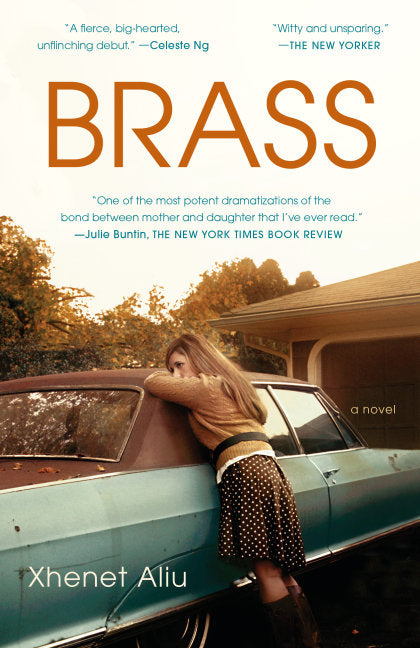
A waitress at the Betsy Ross Diner, Elsie hopes her nickel-and-dime tips will add up to a new life. Then she meets Bashkim, who is at once both worldly and naïve, a married man who left Albania to chase his dreams—and wound up working as a line cook in Waterbury, Connecticut. Back when the brass mills were still open, this bustling factory town drew one wave of immigrants after another. Now it’s the place they can’t seem to leave. Elsie, herself the granddaughter of Lithuanian immigrants, falls in love quickly, but when she learns that she’s pregnant, Elsie can’t help wondering where Bashkim’s heart really lies, and what he’ll do about the wife he left behind.
Seventeen years later, headstrong and independent Luljeta receives a rejection letter from NYU and her first-ever suspension from school on the same day. Instead of striking out on her own in Manhattan, she’s stuck in Connecticut with her mother, Elsie—a fate she refuses to accept. Wondering if the key to her future is unlocking the secrets of the past, Lulu decides to find out what exactly her mother has been hiding about the father she never knew. As she soon discovers, the truth is closer than she ever imagined.
Told in equally gripping parallel narratives with biting wit and grace, Brass announces a fearless new voice with a timely, tender, and quintessentially American story.
Praise for Brass
“Lustrous . . . a tale alive with humor and gumption, of the knotty, needy bond between a mother and daughter . . . [Brass] marks the arrival of a writer whose work will stand the test of time.”—O: The Oprah Magazine
“An exceptional debut novel, one that plumbs the notion of the American Dream while escaping the clichés that pursuit almost always brings with it . . . [Xhenet] Aliu delivers a living, breathing portrait of places left behind.”—The Boston Globe
“The writing blazes on the page. . . . So much about the book is also extraordinarily timely, especially when it focuses on class and culture, and what they really mean.”—San Francisco Chronicle
“Aliu is witty and unsparing in her depiction of the town and its inhabitants, illustrating the granular realities of the struggle for class mobility.”—The New Yorker
STANDARD, PRIMARY, DM AND VARIANT COVERS
Standard and Primary covers are widely available through general retailers. They often have higher print runs and can be cheaper, especially during sales.
In contrast, Direct Market (DM) and variant covers are primarily sold in comic shops. DM editions tend to have more limited availability and may be more valuable to collectors.
The main differences lie in artwork style, availability, price, and collector appeal. Ultimately, the choice between standard and variant covers depends on personal preference, budget, and individual collecting goals.
PRODUCT TYPES
Comic book enthusiasts have various formats to choose from when collecting their favorite stories.
Here's a brief overview of the main types:
Omnibus
- Large, hardcover collections
- Usually contain complete runs or extensive story arcs
- Typically 800-1000+ pages
- Higher price point, often €100-€150
Oversized Hardcover (OHC)
- Similar dimensions to omnibus, but thinner
- Collect shorter runs or story arcs
- Usually 300-600 pages
- Priced between €30-€50
Hardcover (HC)
- Standard-sized hardcover books
- Collect 6-12 issues typically
- Similar dimensions to single issues, but with a hard cover
- Priced around €25-€35
Trade Paperback (TP)
- Softcover collections
- Standard comic book size
- Usually collect 4-6 issues
- Most affordable option, typically €15-€25
Other Formats
- Absolute Editions: Oversized, deluxe hardcovers (mainly DC Comics)
- Compendiums: Massive paperback collections
- Graphic Novels (OGN/GN): Original stories not previously released as single issues
The choice between these formats often depends on personal preference, budget, and collecting goals. Omnibus and OHC editions offer larger artwork and more content but at a higher price, while TPs provide a more affordable way to collect complete story arcs