

Clarkson Potter/Ten Speed
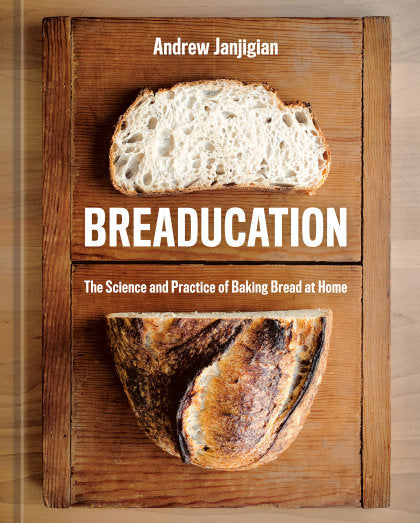
Breaducation
Breaducation
Couldn't load pickup availability
Collapsible content
ABOUT
“The most clear-headed, authoritative, science-driven, and practical guide to bread baking I’ve seen.”—J. Kenji López-Alt, author of The Food Lab and The Wok
Breaducation is for everyone! Whether you're just starting on your bread-baking journey or you're looking to create your own recipes, Andrew Janjigian is here to meet you where you are. For over twenty years, Andrew has been baking bread professional-quality bread and teaching people how to do it.
Now, he brings his years of experience, love for science, and detailed precision to Breaducation. Andrew covers the gamut, from describing every stage in the lifespan of a loaf to a deep dive in the core ingredients in bread baking, and from explaining baker's math to reading and understanding recipe formulas. He covers more advanced techniques as well, from incorporating scalds into your loaves to milling your own grains. And just as he does in Wordloaf, Andrew geeks out over the finer details, such as how temperature, flour type, dough chemistry, your oven, and more impact your final loaf. Recipes include:
• Crusty loaves: Basically Perfect Sourdough, Durum Slab Bread, Cheesy Crits Sourdough, and Rye Scald Miche
• Grain-filled breads: Cream-of-Wheat Sourdough, Cracked Farro Porridge Sourdough Pan Bread, and Rugbrød
• Squishy and fluffy ones: Shokupain de Mie, Challah, and Brioche
• Long and little breads: Baguettes, Parker House "Swolls", and Bagels
• Flat-ish bakes: Fougasse, Pita, and Matnakash (Armenian Fingerprint Flatbread)
• Discarded starter and old bread reuses: Sourdough Olive Oil Granola, Sourdough Boston Brown Bread, and Bread Amino Sauce
Through every iteration of your bakes, Andrew encourages you to build off the techniques you've learned and bring in your own creative flourishes. With many step-by-step photos and illustrations, charts breaking down scaling, hydration percentages, and more, these 50 reliable recipes will teach you what goes into making great bread at home.
STANDARD, PRIMARY, DM AND VARIANT COVERS
Standard and Primary covers are widely available through general retailers. They often have higher print runs and can be cheaper, especially during sales.
In contrast, Direct Market (DM) and variant covers are primarily sold in comic shops. DM editions tend to have more limited availability and may be more valuable to collectors.
The main differences lie in artwork style, availability, price, and collector appeal. Ultimately, the choice between standard and variant covers depends on personal preference, budget, and individual collecting goals.
PRODUCT TYPES
Comic book enthusiasts have various formats to choose from when collecting their favorite stories.
Here's a brief overview of the main types:
Omnibus
- Large, hardcover collections
- Usually contain complete runs or extensive story arcs
- Typically 800-1000+ pages
- Higher price point, often €100-€150
Oversized Hardcover (OHC)
- Similar dimensions to omnibus, but thinner
- Collect shorter runs or story arcs
- Usually 300-600 pages
- Priced between €30-€50
Hardcover (HC)
- Standard-sized hardcover books
- Collect 6-12 issues typically
- Similar dimensions to single issues, but with a hard cover
- Priced around €25-€35
Trade Paperback (TP)
- Softcover collections
- Standard comic book size
- Usually collect 4-6 issues
- Most affordable option, typically €15-€25
Other Formats
- Absolute Editions: Oversized, deluxe hardcovers (mainly DC Comics)
- Compendiums: Massive paperback collections
- Graphic Novels (OGN/GN): Original stories not previously released as single issues
The choice between these formats often depends on personal preference, budget, and collecting goals. Omnibus and OHC editions offer larger artwork and more content but at a higher price, while TPs provide a more affordable way to collect complete story arcs