

Crown
Breaking Out of Bedlam
Breaking Out of Bedlam
Couldn't load pickup availability
Collapsible content
ABOUT
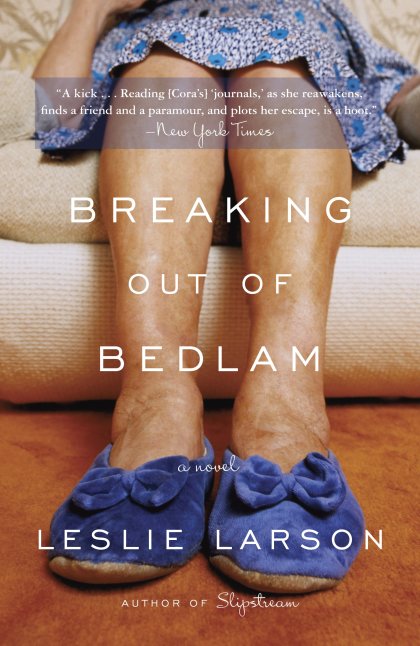
So what if her house is in shambles? Who cares when she last changed her clothes? If an eighty-two-year-old widow wants to live on junk food, pills, and cigarettes, hasn’t she earned the right? When her kids force her into The Palisades, an assisted living facility, Cora takes to her bed, planning to die as soon as possible. But life isn’t finished with her yet, not by a long shot.
Deciding that truth is the best revenge, Cora begins to write a tell-all journal that reveals once and for all the secret she has guarded since she was a young woman. In entries that are profane, profound, and gossipy, she chronicles her childhood in rural Missouri, her shotgun wedding, and the terrible event that changed the course of her life.
Intermingled with her reminiscences is an account of the day-to-day dramas at The Palisades—her budding romance with a suave new resident, feuds with her tablemates, her rollicking camaraderie with the man who oversees her health care, and the sinister cloud of suspicion that descends as a series of petty crimes sets everyone on edge. The story builds to a powerful climax as Cora’s revelations about her past mesh with the unraveling intrigue in the present.
Cora is by turns outrageous, irreverent, and wickedly funny. Despite a life with more than its share of disappointment and struggle, she refuses to go gently into her twilight years, remaining intensely curious, disinclined to play it safe, and willing to start over.
Breaking Out of Bedlam captures the loneliness and secrets that lurk within families, the hardscrabble reality facing women with limited resources, and the resilience of a woman who survives, despite all the odds, through an unlikely combination of passion, humor, and faith.
“Tough-edged Cora Sledge, 82, is a reluctant resident of The Palisades nursing home—a ‘prison [where] your only crime is you lived too long.’ Her tell-all journal, recounting dramas at the home (thefts, love affairs, rivalries) and a tragedy buried in her past, is profane, harrowing, comical—and Cora’s voice is spot-on.”—AARP Magazine
STANDARD, PRIMARY, DM AND VARIANT COVERS
Standard and Primary covers are widely available through general retailers. They often have higher print runs and can be cheaper, especially during sales.
In contrast, Direct Market (DM) and variant covers are primarily sold in comic shops. DM editions tend to have more limited availability and may be more valuable to collectors.
The main differences lie in artwork style, availability, price, and collector appeal. Ultimately, the choice between standard and variant covers depends on personal preference, budget, and individual collecting goals.
PRODUCT TYPES
Comic book enthusiasts have various formats to choose from when collecting their favorite stories.
Here's a brief overview of the main types:
Omnibus
- Large, hardcover collections
- Usually contain complete runs or extensive story arcs
- Typically 800-1000+ pages
- Higher price point, often €100-€150
Oversized Hardcover (OHC)
- Similar dimensions to omnibus, but thinner
- Collect shorter runs or story arcs
- Usually 300-600 pages
- Priced between €30-€50
Hardcover (HC)
- Standard-sized hardcover books
- Collect 6-12 issues typically
- Similar dimensions to single issues, but with a hard cover
- Priced around €25-€35
Trade Paperback (TP)
- Softcover collections
- Standard comic book size
- Usually collect 4-6 issues
- Most affordable option, typically €15-€25
Other Formats
- Absolute Editions: Oversized, deluxe hardcovers (mainly DC Comics)
- Compendiums: Massive paperback collections
- Graphic Novels (OGN/GN): Original stories not previously released as single issues
The choice between these formats often depends on personal preference, budget, and collecting goals. Omnibus and OHC editions offer larger artwork and more content but at a higher price, while TPs provide a more affordable way to collect complete story arcs