

Random House Publishing Group
Broken Glass
Broken Glass
Couldn't load pickup availability
Collapsible content
ABOUT
“An intimate portrait . . . alive with architectural intrigue.”—Architect Magazine
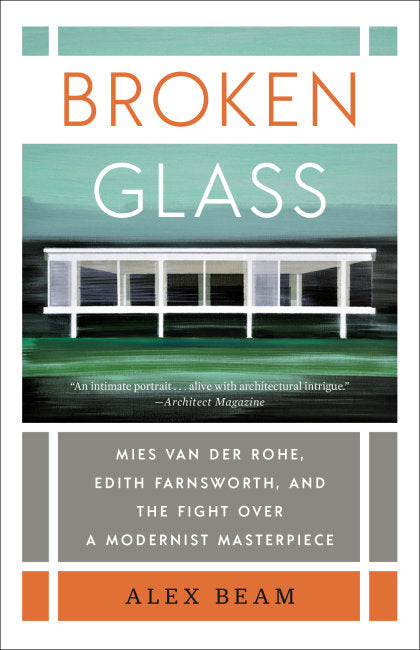
In 1945, Edith Farnsworth asked the German architect Mies van der Rohe, already renowned for his avant-garde buildings, to design a weekend home for her outside of Chicago. Edith was a woman ahead of her time—unmarried, she was a distinguished medical researcher, as well as an accomplished violinist, translator, and poet. The two quickly began spending weekends together, talking philosophy, Catholic mysticism, and, of course, architecture over wine-soaked picnic lunches. Their personal and professional collaboration would produce the Farnsworth House, one of the most important works of architecture of all time, a blindingly original structure made up almost entirely of glass and steel.
But the minimalist marvel, built in 1951, was plagued by cost overruns and a sudden chilling of the two friends’ mutual affection. Though the building became world famous, Edith found it impossible to live in, because of its constant leaks, flooding, and complete lack of privacy. Alienated and aggrieved, she lent her name to a public campaign against Mies, cheered on by Frank Lloyd Wright. Mies, in turn, sued her for unpaid monies. The ensuing lengthy trial heard evidence of purported incompetence by an acclaimed architect, and allegations of psychological cruelty and emotional trauma. A commercial dispute litigated in a rural Illinois courthouse became a trial of modernist art and architecture itself.
Interweaving personal drama and cultural history, Alex Beam presents a stylish, enthralling narrative tapestry, illuminating the fascinating history behind one of the twentieth century’s most beautiful and significant architectural projects.
STANDARD, PRIMARY, DM AND VARIANT COVERS
Standard and Primary covers are widely available through general retailers. They often have higher print runs and can be cheaper, especially during sales.
In contrast, Direct Market (DM) and variant covers are primarily sold in comic shops. DM editions tend to have more limited availability and may be more valuable to collectors.
The main differences lie in artwork style, availability, price, and collector appeal. Ultimately, the choice between standard and variant covers depends on personal preference, budget, and individual collecting goals.
PRODUCT TYPES
Comic book enthusiasts have various formats to choose from when collecting their favorite stories.
Here's a brief overview of the main types:
Omnibus
- Large, hardcover collections
- Usually contain complete runs or extensive story arcs
- Typically 800-1000+ pages
- Higher price point, often €100-€150
Oversized Hardcover (OHC)
- Similar dimensions to omnibus, but thinner
- Collect shorter runs or story arcs
- Usually 300-600 pages
- Priced between €30-€50
Hardcover (HC)
- Standard-sized hardcover books
- Collect 6-12 issues typically
- Similar dimensions to single issues, but with a hard cover
- Priced around €25-€35
Trade Paperback (TP)
- Softcover collections
- Standard comic book size
- Usually collect 4-6 issues
- Most affordable option, typically €15-€25
Other Formats
- Absolute Editions: Oversized, deluxe hardcovers (mainly DC Comics)
- Compendiums: Massive paperback collections
- Graphic Novels (OGN/GN): Original stories not previously released as single issues
The choice between these formats often depends on personal preference, budget, and collecting goals. Omnibus and OHC editions offer larger artwork and more content but at a higher price, while TPs provide a more affordable way to collect complete story arcs