

Random House Publishing Group
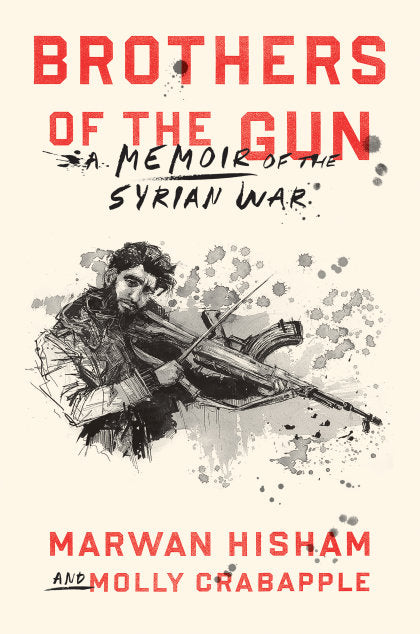
Brothers of the Gun
Brothers of the Gun
Couldn't load pickup availability
Collapsible content
ABOUT
“This powerful memoir, illuminated with Molly Crabapple’s extraordinary art, provides a rare lens through which we can see a region in deadly conflict.”—Bryan Stevenson, author of Just Mercy
In 2011, Marwan Hisham and his two friends—fellow working-class college students Nael and Tareq—joined the first protests of the Arab Spring in Syria, in response to a recent massacre. Arm-in-arm they marched, poured Coca-Cola into one another’s eyes to blunt the effects of tear gas, ran from the security forces, and cursed the country’s president, Bashar al-Assad. It was ecstasy. A long-bottled revolution was finally erupting, and freedom from a brutal dictator seemed, at last, imminent. Five years later, the three young friends were scattered: one now an Islamist revolutionary, another dead at the hands of government soldiers, and the last, Marwan, now a journalist in Turkish exile, trying to find a way back to a homeland reduced to rubble.
Marwan was there to witness and document firsthand the Syrian war, from its inception to the present. He watched from the rooftops as regime warplanes bombed soldiers; as revolutionary activist groups, for a few dreamy days, spray-painted hope on Raqqa; as his friends died or threw in their lot with Islamist fighters. He became a journalist by courageously tweeting out news from a city under siege by ISIS, the Russians, and the Americans all at once. He saw the country that ran through his veins—the country that held his hopes, dreams, and fears—be destroyed in front of him, and eventually joined the relentless stream of refugees risking their lives to escape.
Illustrated with more than eighty ink drawings by Molly Crabapple that bring to life the beauty and chaos, Brothers of the Gun offers a ground-level reflection on the Syrian revolution—and how it bled into international catastrophe and global war. This is a story of pragmatism and idealism, impossible violence and repression, and, even in the midst of war, profound acts of courage, creativity, and hope.
“A book of startling emotional power and intellectual depth.”—Pankaj Mishra, author of Age of Anger and From the Ruins of Empire
“A revelatory and necessary read on one of the most destructive wars of our time.”—Angela Davis
STANDARD, PRIMARY, DM AND VARIANT COVERS
Standard and Primary covers are widely available through general retailers. They often have higher print runs and can be cheaper, especially during sales.
In contrast, Direct Market (DM) and variant covers are primarily sold in comic shops. DM editions tend to have more limited availability and may be more valuable to collectors.
The main differences lie in artwork style, availability, price, and collector appeal. Ultimately, the choice between standard and variant covers depends on personal preference, budget, and individual collecting goals.
PRODUCT TYPES
Comic book enthusiasts have various formats to choose from when collecting their favorite stories.
Here's a brief overview of the main types:
Omnibus
- Large, hardcover collections
- Usually contain complete runs or extensive story arcs
- Typically 800-1000+ pages
- Higher price point, often €100-€150
Oversized Hardcover (OHC)
- Similar dimensions to omnibus, but thinner
- Collect shorter runs or story arcs
- Usually 300-600 pages
- Priced between €30-€50
Hardcover (HC)
- Standard-sized hardcover books
- Collect 6-12 issues typically
- Similar dimensions to single issues, but with a hard cover
- Priced around €25-€35
Trade Paperback (TP)
- Softcover collections
- Standard comic book size
- Usually collect 4-6 issues
- Most affordable option, typically €15-€25
Other Formats
- Absolute Editions: Oversized, deluxe hardcovers (mainly DC Comics)
- Compendiums: Massive paperback collections
- Graphic Novels (OGN/GN): Original stories not previously released as single issues
The choice between these formats often depends on personal preference, budget, and collecting goals. Omnibus and OHC editions offer larger artwork and more content but at a higher price, while TPs provide a more affordable way to collect complete story arcs