

Random House Publishing Group
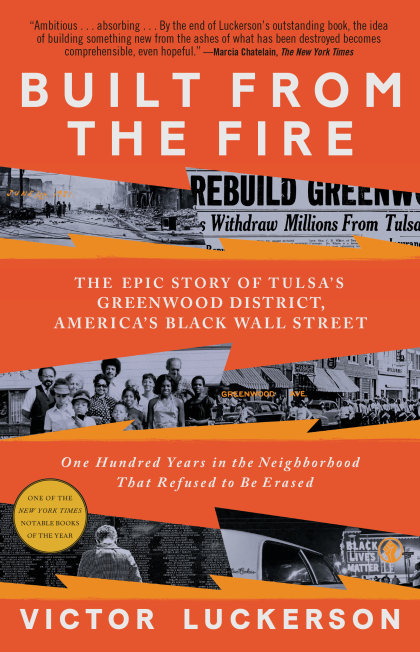
Built from the Fire
Built from the Fire
Couldn't load pickup availability
Collapsible content
ABOUT
“Ambitious . . . absorbing . . . By the end of Luckerson’s outstanding book, the idea of building something new from the ashes of what has been destroyed becomes comprehensible, even hopeful.”—Marcia Chatelain, The New York Times
WINNER: The Dayton Literary Peace Prize; The MAAH Stone Book Award; The SABEW Best in Business Book Award; The Lillian Smith Book Award; The Oklahoma Historical Society’s E. E. Dale Award
FINALIST: The Hurston/Wright Legacy Award
A NEW YORK TIMES BOOK REVIEW AND WASHINGTON POST BEST BOOK OF THE YEAR
When Ed Goodwin moved with his parents to the Greenwood neighborhood in Tulsa, Oklahoma, his family joined a community soon to become the center of black life in the West. But just a few years later, on May 31, 1921, the teenaged Ed hid in a bathtub as a white mob descended on his neighborhood, laying waste to thirty-five blocks and murdering as many as three hundred people in one of the worst acts of racist violence in U.S. history.
The Goodwins and their neighbors soon rebuilt the district into “a Mecca,” in Ed’s words, where nightlife thrived and small businesses flourished. Ed bought a newspaper to chronicle Greenwood’s resurgence and battles against white bigotry, and his son Jim, an attorney, embodied the family’s hopes for the civil rights movement. But by the 1970s urban renewal policies had nearly emptied the neighborhood. Today the newspaper remains, and Ed’s granddaughter Regina represents the neighborhood in the Oklahoma state legislature, working alongside a new generation of local activists to revive it once again.
In Built from the Fire, journalist Victor Luckerson tells the true story behind a potent national symbol of success and solidarity and weaves an epic tale about a neighborhood that refused, more than once, to be erased.
STANDARD, PRIMARY, DM AND VARIANT COVERS
Standard and Primary covers are widely available through general retailers. They often have higher print runs and can be cheaper, especially during sales.
In contrast, Direct Market (DM) and variant covers are primarily sold in comic shops. DM editions tend to have more limited availability and may be more valuable to collectors.
The main differences lie in artwork style, availability, price, and collector appeal. Ultimately, the choice between standard and variant covers depends on personal preference, budget, and individual collecting goals.
PRODUCT TYPES
Comic book enthusiasts have various formats to choose from when collecting their favorite stories.
Here's a brief overview of the main types:
Omnibus
- Large, hardcover collections
- Usually contain complete runs or extensive story arcs
- Typically 800-1000+ pages
- Higher price point, often €100-€150
Oversized Hardcover (OHC)
- Similar dimensions to omnibus, but thinner
- Collect shorter runs or story arcs
- Usually 300-600 pages
- Priced between €30-€50
Hardcover (HC)
- Standard-sized hardcover books
- Collect 6-12 issues typically
- Similar dimensions to single issues, but with a hard cover
- Priced around €25-€35
Trade Paperback (TP)
- Softcover collections
- Standard comic book size
- Usually collect 4-6 issues
- Most affordable option, typically €15-€25
Other Formats
- Absolute Editions: Oversized, deluxe hardcovers (mainly DC Comics)
- Compendiums: Massive paperback collections
- Graphic Novels (OGN/GN): Original stories not previously released as single issues
The choice between these formats often depends on personal preference, budget, and collecting goals. Omnibus and OHC editions offer larger artwork and more content but at a higher price, while TPs provide a more affordable way to collect complete story arcs