

Penguin Publishing Group
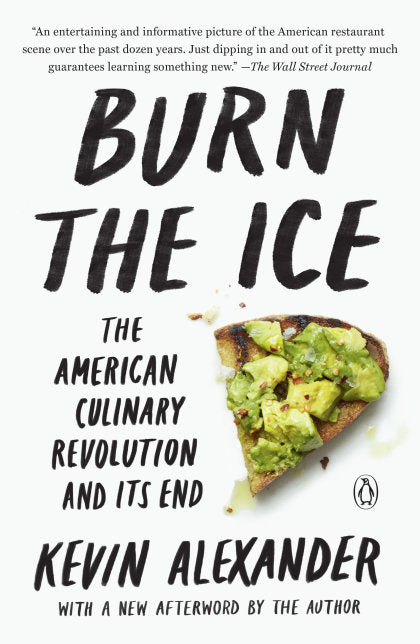
Burn the Ice
Burn the Ice
Couldn't load pickup availability
Collapsible content
ABOUT
James Beard Award-winning food journalist Kevin Alexander traces an exhilarating golden age in American dining—with a new Afterword addressing the devastating consequences of the coronavirus pandemic on the restaurant industry
Over the past decade, Kevin Alexander saw American dining turned on its head. Starting in 2006, the food world underwent a transformation as the established gatekeepers of American culinary creativity in New York City and the Bay Area were forced to contend with Portland, Oregon. Its new, no-holds-barred, casual fine-dining style became a template for other cities, and a culinary revolution swept across America. Traditional ramen shops opened in Oklahoma City. Craft cocktail speakeasies appeared in Boise. Poke bowls sprung up in Omaha. Entire neighborhoods, like Williamsburg in Brooklyn, and cities like Austin, were suddenly unrecognizable to long-term residents, their names becoming shorthand for the so-called hipster movement. At the same time, new media companies such as Eater and Serious Eats launched to chronicle and cater to this developing scene, transforming nascent star chefs into proper celebrities. Emerging culinary television hosts like Anthony Bourdain inspired a generation to use food as the lens for different cultures. It seemed, for a moment, like a glorious belle epoque of eating and drinking in America. And then it was over.
To tell this story, Alexander journeys through the travails and triumphs of a number of key chefs, bartenders, and activists, as well as restaurants and neighborhoods whose fortunes were made during this veritable gold rush--including Gabriel Rucker, an originator of the 2006 Portland restaurant scene; Tom Colicchio of Gramercy Tavern and Top Chef fame; as well as hugely influential figures, such as André Prince Jeffries of Prince's Hot Chicken Shack in Nashville; and Carolina barbecue pitmaster Rodney Scott.
He writes with rare energy, telling a distinctly American story, at once timeless and cutting-edge, about unbridled creativity and ravenous ambition. To "burn the ice" means to melt down whatever remains in a kitchen's ice machine at the end of the night. Or, at the bar, to melt the ice if someone has broken a glass in the well. It is both an end and a beginning. It is the firsthand story of a revolution in how Americans eat and drink.
STANDARD, PRIMARY, DM AND VARIANT COVERS
Standard and Primary covers are widely available through general retailers. They often have higher print runs and can be cheaper, especially during sales.
In contrast, Direct Market (DM) and variant covers are primarily sold in comic shops. DM editions tend to have more limited availability and may be more valuable to collectors.
The main differences lie in artwork style, availability, price, and collector appeal. Ultimately, the choice between standard and variant covers depends on personal preference, budget, and individual collecting goals.
PRODUCT TYPES
Comic book enthusiasts have various formats to choose from when collecting their favorite stories.
Here's a brief overview of the main types:
Omnibus
- Large, hardcover collections
- Usually contain complete runs or extensive story arcs
- Typically 800-1000+ pages
- Higher price point, often €100-€150
Oversized Hardcover (OHC)
- Similar dimensions to omnibus, but thinner
- Collect shorter runs or story arcs
- Usually 300-600 pages
- Priced between €30-€50
Hardcover (HC)
- Standard-sized hardcover books
- Collect 6-12 issues typically
- Similar dimensions to single issues, but with a hard cover
- Priced around €25-€35
Trade Paperback (TP)
- Softcover collections
- Standard comic book size
- Usually collect 4-6 issues
- Most affordable option, typically €15-€25
Other Formats
- Absolute Editions: Oversized, deluxe hardcovers (mainly DC Comics)
- Compendiums: Massive paperback collections
- Graphic Novels (OGN/GN): Original stories not previously released as single issues
The choice between these formats often depends on personal preference, budget, and collecting goals. Omnibus and OHC editions offer larger artwork and more content but at a higher price, while TPs provide a more affordable way to collect complete story arcs