

Penguin Publishing Group
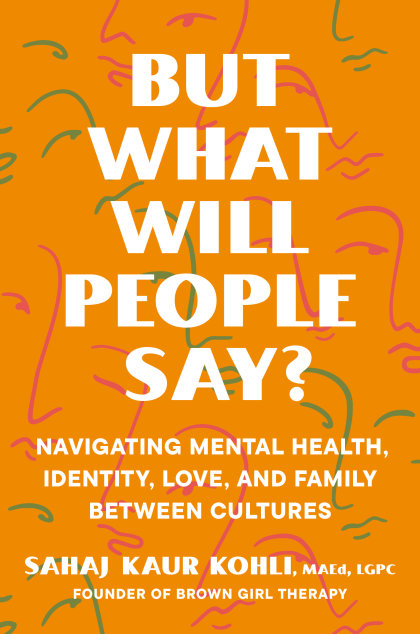
But What Will People Say?
But What Will People Say?
Couldn't load pickup availability
Collapsible content
ABOUT
“This wonderful book is a compass, a blueprint, a mirror, and a friend. Kohli gives language to what many of us feel but can’t yet articulate.”—Erika L. Sánchez, New York Times bestselling author of I am Not Your Perfect Mexican Daughter
“Loving, culturally informed, and holistic... [Kohli] compassionately shares her own story, and guides readers through the nuances and pain of assimilation, individuation, and mental health. How I wish I had this book back when I was trying to figure it all out for myself!” —Ramani Durvasula, PhD, author of It’s Not You
A deeply personal, paradigm-shifting book rethinking traditional therapy and self-care, creating much-needed space for those left out of the narrative
Writer and therapist Sahaj Kaur Kohli grew up knowing exactly what it means to straddle multiple cultures at once. Like many children of immigrants, she has often found herself plagued by questions: Can I establish my own values and embrace where I come from? Is prioritizing my mental health really rejecting my culture? How do I set boundaries and care for myself when family and community mean everything? Even after becoming a therapist herself, she saw those same gaps in the mental health world, leading her to wonder, like so many children of immigrants: what about us?
While conversations around mental health are becoming increasingly open, our models remain largely Eurocentric and focused on individuality. Sahaj has sought to challenge these long-held models, using deep personal reflection, therapy, community building, and a whole lot of trial and error, eventually navigating her own way to understanding and acceptance. Here, she shows us how to get there, all the while reminding us that personal healing is inextricably connected to collective healing.
But What Will People Say? elegantly weaves together personal narrative, anecdotal analysis, and comprehensive research. Sahaj offers advice and tools for everything from navigating generational trauma, guilt, and boundaries, to breaking down stigmas around therapy and celebrating cultural duality. Democratizing and decolonizing the way we think about mental health and self-help, Sahaj’s incredible work is nothing short of a revolution.
STANDARD, PRIMARY, DM AND VARIANT COVERS
Standard and Primary covers are widely available through general retailers. They often have higher print runs and can be cheaper, especially during sales.
In contrast, Direct Market (DM) and variant covers are primarily sold in comic shops. DM editions tend to have more limited availability and may be more valuable to collectors.
The main differences lie in artwork style, availability, price, and collector appeal. Ultimately, the choice between standard and variant covers depends on personal preference, budget, and individual collecting goals.
PRODUCT TYPES
Comic book enthusiasts have various formats to choose from when collecting their favorite stories.
Here's a brief overview of the main types:
Omnibus
- Large, hardcover collections
- Usually contain complete runs or extensive story arcs
- Typically 800-1000+ pages
- Higher price point, often €100-€150
Oversized Hardcover (OHC)
- Similar dimensions to omnibus, but thinner
- Collect shorter runs or story arcs
- Usually 300-600 pages
- Priced between €30-€50
Hardcover (HC)
- Standard-sized hardcover books
- Collect 6-12 issues typically
- Similar dimensions to single issues, but with a hard cover
- Priced around €25-€35
Trade Paperback (TP)
- Softcover collections
- Standard comic book size
- Usually collect 4-6 issues
- Most affordable option, typically €15-€25
Other Formats
- Absolute Editions: Oversized, deluxe hardcovers (mainly DC Comics)
- Compendiums: Massive paperback collections
- Graphic Novels (OGN/GN): Original stories not previously released as single issues
The choice between these formats often depends on personal preference, budget, and collecting goals. Omnibus and OHC editions offer larger artwork and more content but at a higher price, while TPs provide a more affordable way to collect complete story arcs