

Knopf Doubleday Publishing Group
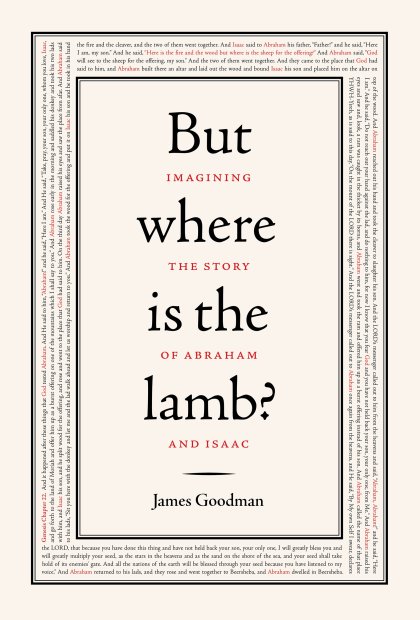
But Where Is the Lamb?
But Where Is the Lamb?
Couldn't load pickup availability
Collapsible content
ABOUT
“I didn’t think he’d do it. I really didn’t think he would. I thought he’d say, whoa, hold on, wait a minute. We made a deal, remember, the land, the blessing, the nation, the descendants as numerous as the sands on the shore and the stars in the sky.”
So begins James Goodman’s original and urgent encounter with one of the most compelling and resonant stories ever told—God’s command to Abraham to sacrifice his son Isaac.
A mere nineteen lines in the book of Genesis, it rests at the heart of the history, literature, theology, and sacred rituals of Judaism, Christianity, and Islam. For more than two millennia, people throughout the world have grappled with the troubling questions about sacrifice, authority, obedience, and faith to which the story gives rise. Writing from the vantage of “a reader, a son, a Jew, a father, a skeptic, a historian, a lover of stories, and a writer,” Goodman gives us an enthralling narrative history that moves from its biblical origins to its place in the cultures and faiths of our time. He introduces us to the commentary of Second Temple sages, rabbis and priests of the late antiquity, and early Islamic exegetes (some of whom imagined that Ishmael was the nearly sacrificed son). He examines Syriac hymns (in which Sarah stars), Hebrew chronicles of the First Crusade (in which Isaac often dies), and medieval English mystery plays. He looks at the art of Europe’s golden age, the philosophy of Kant and Kierkegaard, and the panoply of twentieth-century interpretation, sacred and profane, including the work of Bob Dylan, Elie Wiesel, and A. B. Yehoshua. In illuminating how so many others have understood this story, Goodman tells a gripping and provocative story of his own.
STANDARD, PRIMARY, DM AND VARIANT COVERS
Standard and Primary covers are widely available through general retailers. They often have higher print runs and can be cheaper, especially during sales.
In contrast, Direct Market (DM) and variant covers are primarily sold in comic shops. DM editions tend to have more limited availability and may be more valuable to collectors.
The main differences lie in artwork style, availability, price, and collector appeal. Ultimately, the choice between standard and variant covers depends on personal preference, budget, and individual collecting goals.
PRODUCT TYPES
Comic book enthusiasts have various formats to choose from when collecting their favorite stories.
Here's a brief overview of the main types:
Omnibus
- Large, hardcover collections
- Usually contain complete runs or extensive story arcs
- Typically 800-1000+ pages
- Higher price point, often €100-€150
Oversized Hardcover (OHC)
- Similar dimensions to omnibus, but thinner
- Collect shorter runs or story arcs
- Usually 300-600 pages
- Priced between €30-€50
Hardcover (HC)
- Standard-sized hardcover books
- Collect 6-12 issues typically
- Similar dimensions to single issues, but with a hard cover
- Priced around €25-€35
Trade Paperback (TP)
- Softcover collections
- Standard comic book size
- Usually collect 4-6 issues
- Most affordable option, typically €15-€25
Other Formats
- Absolute Editions: Oversized, deluxe hardcovers (mainly DC Comics)
- Compendiums: Massive paperback collections
- Graphic Novels (OGN/GN): Original stories not previously released as single issues
The choice between these formats often depends on personal preference, budget, and collecting goals. Omnibus and OHC editions offer larger artwork and more content but at a higher price, while TPs provide a more affordable way to collect complete story arcs