

Penguin Publishing Group
Cherish Farrah
Cherish Farrah
Couldn't load pickup availability
Collapsible content
ABOUT
AN APRIL 2022 BELLETRIST BOOK CLUB PICK
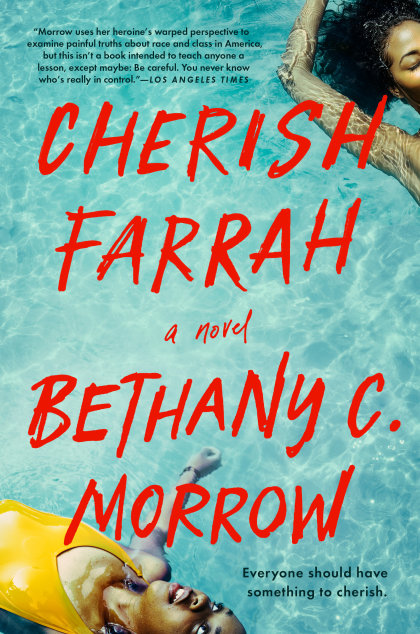
“Morrow uses her heroine’s warped perspective to examine painful truths about race and class in America, but this isn’t a book intended to teach anyone a lesson, except maybe: Be careful. You never know who’s really in control.”—Los Angeles Times
From bestselling author Bethany C. Morrow comes a new adult social horror novel in the vein of Get Out meets My Sister, the Serial Killer, about Farrah, a young, calculating Black girl who manipulates her way into the lives of her Black best friend’s white, wealthy, adoptive family but soon suspects she may not be the only one with ulterior motives. . . .
Seventeen-year-old Farrah Turner is one of two Black girls in her country club community, and the only one with Black parents. Her best friend, Cherish Whitman, adopted by a white, wealthy family, is something Farrah likes to call WGS—White Girl Spoiled. With Brianne and Jerry Whitman as parents, Cherish is given the kind of adoration and coddling that even upper-class Black parents can’t seem to afford—and it creates a dissonance in her best friend that Farrah can exploit. When her own family is unexpectedly confronted with foreclosure, the calculating Farrah is determined to reassert the control she’s convinced she’s always had over her life by staying with Cherish, the only person she loves—even when she hates her.
As troubled Farrah manipulates her way further into the Whitman family, the longer she stays, the more her own parents suggest that something is wrong in the Whitman house. She might trust them—if they didn’t think something was wrong with Farrah, too. When strange things start happening at the Whitman household—debilitating illnesses, upsetting fever dreams, an inexplicable tension with Cherish’s hotheaded boyfriend, and a mysterious journal that seems to keep track of what is happening to Farrah—it’s nothing she can’t handle. But soon everything begins to unravel when the Whitmans invite Farrah closer, and it’s anyone’s guess who is really in control.
Told in Farrah’s chilling, unforgettable voice and weaving in searing commentary on race and class, this slow-burn social horror will keep you on the edge of your seat until the last page.
STANDARD, PRIMARY, DM AND VARIANT COVERS
Standard and Primary covers are widely available through general retailers. They often have higher print runs and can be cheaper, especially during sales.
In contrast, Direct Market (DM) and variant covers are primarily sold in comic shops. DM editions tend to have more limited availability and may be more valuable to collectors.
The main differences lie in artwork style, availability, price, and collector appeal. Ultimately, the choice between standard and variant covers depends on personal preference, budget, and individual collecting goals.
PRODUCT TYPES
Comic book enthusiasts have various formats to choose from when collecting their favorite stories.
Here's a brief overview of the main types:
Omnibus
- Large, hardcover collections
- Usually contain complete runs or extensive story arcs
- Typically 800-1000+ pages
- Higher price point, often €100-€150
Oversized Hardcover (OHC)
- Similar dimensions to omnibus, but thinner
- Collect shorter runs or story arcs
- Usually 300-600 pages
- Priced between €30-€50
Hardcover (HC)
- Standard-sized hardcover books
- Collect 6-12 issues typically
- Similar dimensions to single issues, but with a hard cover
- Priced around €25-€35
Trade Paperback (TP)
- Softcover collections
- Standard comic book size
- Usually collect 4-6 issues
- Most affordable option, typically €15-€25
Other Formats
- Absolute Editions: Oversized, deluxe hardcovers (mainly DC Comics)
- Compendiums: Massive paperback collections
- Graphic Novels (OGN/GN): Original stories not previously released as single issues
The choice between these formats often depends on personal preference, budget, and collecting goals. Omnibus and OHC editions offer larger artwork and more content but at a higher price, while TPs provide a more affordable way to collect complete story arcs