

Random House Publishing Group
Colored People Time
Colored People Time
Couldn't load pickup availability
Collapsible content
ABOUT
“Brilliantly argues that after toiling to build this country for free or reduced wages, people of color not only deserve the extra time for themselves, but they should be afforded the opportunity to be late for anything they want.”—Essence (Must-Read Spring Books)
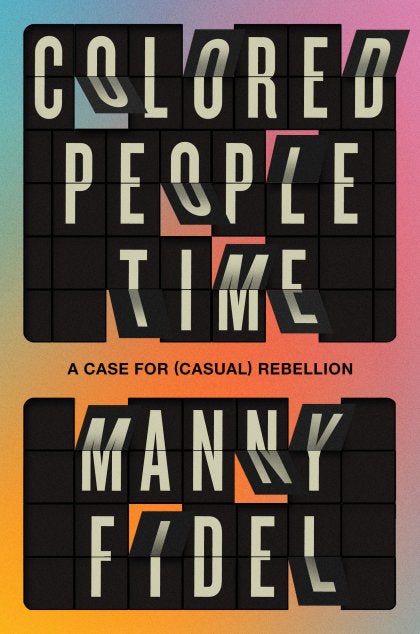
In Colored People Time, Manny Fidel explores how race, culture, and history shape not only our lives, but our sense of time itself. Through sharp, personal, and often humorous essays, Fidel interrogates the politics of punctuality, the myth of linear progress, and some of the ways people of color are forced to navigate a world that rarely moves at their pace or in their favor.
In this collection of essays, Fidel confronts the systems that structure time around identity and power and invites readers to interrogate the way time folds around them, jovially arguing that until America reaches genuine racial equity, people of color should be encouraged to be late to anything they want. Since our country's inception, the gears that operate it have been oiled to privilege some over others, and the result is that they have fewer barriers to timeliness. For Black and brown people, any number of offenses—grave, minor, or pettily imagined—can gum us up. Fidel argues we deserve the extra time to ourselves. And not for nothing, race relations in the US—by design—are advancing in their own molasses-like pace, ever shifting the ETAs of justice and freedom. Fidel incisively builds this argument in essays like “Summer ‘16,” a nostalgic exploration of a dearly-held season, and “Ocarina of Time,” a meditation on near-death and time travel via video game.
Infused with insights from history, pop culture, and Fidel’s own personal experiences, Colored People Time is not just about lateness. It's about how time works differently depending on who you are and where you stand.
STANDARD, PRIMARY, DM AND VARIANT COVERS
Standard and Primary covers are widely available through general retailers. They often have higher print runs and can be cheaper, especially during sales.
In contrast, Direct Market (DM) and variant covers are primarily sold in comic shops. DM editions tend to have more limited availability and may be more valuable to collectors.
The main differences lie in artwork style, availability, price, and collector appeal. Ultimately, the choice between standard and variant covers depends on personal preference, budget, and individual collecting goals.
PRODUCT TYPES
Comic book enthusiasts have various formats to choose from when collecting their favorite stories.
Here's a brief overview of the main types:
Omnibus
- Large, hardcover collections
- Usually contain complete runs or extensive story arcs
- Typically 800-1000+ pages
- Higher price point, often €100-€150
Oversized Hardcover (OHC)
- Similar dimensions to omnibus, but thinner
- Collect shorter runs or story arcs
- Usually 300-600 pages
- Priced between €30-€50
Hardcover (HC)
- Standard-sized hardcover books
- Collect 6-12 issues typically
- Similar dimensions to single issues, but with a hard cover
- Priced around €25-€35
Trade Paperback (TP)
- Softcover collections
- Standard comic book size
- Usually collect 4-6 issues
- Most affordable option, typically €15-€25
Other Formats
- Absolute Editions: Oversized, deluxe hardcovers (mainly DC Comics)
- Compendiums: Massive paperback collections
- Graphic Novels (OGN/GN): Original stories not previously released as single issues
The choice between these formats often depends on personal preference, budget, and collecting goals. Omnibus and OHC editions offer larger artwork and more content but at a higher price, while TPs provide a more affordable way to collect complete story arcs