

Beacon Press
Considering Hate
Considering Hate
Couldn't load pickup availability
Collapsible content
ABOUT
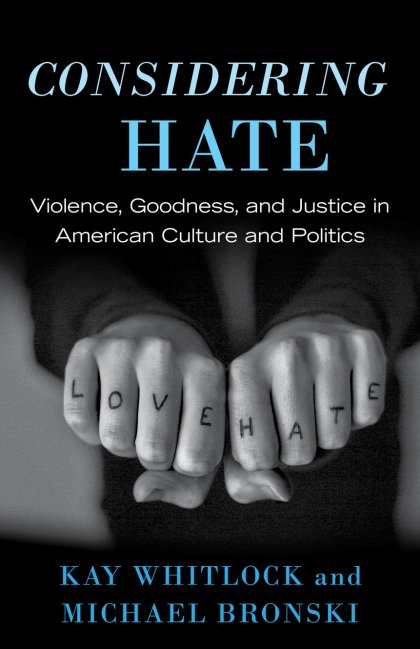
Over the centuries American society has been plagued by brutality fueled by disregard for the humanity of others: systemic violence against Native peoples, black people, and immigrants. More recent examples include the Steubenville rape case and the murders of Matthew Shepard, Jennifer Daugherty, Marcelo Lucero, and Trayvon Martin. Most Americans see such acts as driven by hate. But is this right? Longtime activists and political theorists Kay Whitlock and Michael Bronski boldly assert that American society’s reliance on the framework of hate to explain these acts is wrongheaded, misleading, and ultimately harmful.
All too often Americans choose to believe that terrible cruelty is aberrant, caused primarily by “extremists” and misfits. The inevitable remedy of intensified government-based policing, increased surveillance, and harsher punishments has never worked and does not work now. Stand-your-ground laws; the US prison system; police harassment of people of color, women, and LGBT people; and the so-called war on terror demonstrate that the remedies themselves are forms of institutionalized violence.
Considering Hate challenges easy assumptions and failed solutions, arguing that “hate violence” reflects existing cultural norms. Drawing upon social science, philosophy, theology, film, and literature, the authors examine how hate and common, even ordinary, forms of individual and group violence are excused and normalized in popular culture and political discussion. This massive denial of brutal reality profoundly warps society’s ideas about goodness and justice.
Whitlock and Bronski invite readers to radically reimagine the meaning and structures of justice within a new framework of community wholeness, collective responsibility, and civic goodness.
STANDARD, PRIMARY, DM AND VARIANT COVERS
Standard and Primary covers are widely available through general retailers. They often have higher print runs and can be cheaper, especially during sales.
In contrast, Direct Market (DM) and variant covers are primarily sold in comic shops. DM editions tend to have more limited availability and may be more valuable to collectors.
The main differences lie in artwork style, availability, price, and collector appeal. Ultimately, the choice between standard and variant covers depends on personal preference, budget, and individual collecting goals.
PRODUCT TYPES
Comic book enthusiasts have various formats to choose from when collecting their favorite stories.
Here's a brief overview of the main types:
Omnibus
- Large, hardcover collections
- Usually contain complete runs or extensive story arcs
- Typically 800-1000+ pages
- Higher price point, often €100-€150
Oversized Hardcover (OHC)
- Similar dimensions to omnibus, but thinner
- Collect shorter runs or story arcs
- Usually 300-600 pages
- Priced between €30-€50
Hardcover (HC)
- Standard-sized hardcover books
- Collect 6-12 issues typically
- Similar dimensions to single issues, but with a hard cover
- Priced around €25-€35
Trade Paperback (TP)
- Softcover collections
- Standard comic book size
- Usually collect 4-6 issues
- Most affordable option, typically €15-€25
Other Formats
- Absolute Editions: Oversized, deluxe hardcovers (mainly DC Comics)
- Compendiums: Massive paperback collections
- Graphic Novels (OGN/GN): Original stories not previously released as single issues
The choice between these formats often depends on personal preference, budget, and collecting goals. Omnibus and OHC editions offer larger artwork and more content but at a higher price, while TPs provide a more affordable way to collect complete story arcs