

Crown
Crash Landing
Crash Landing
Couldn't load pickup availability
Collapsible content
ABOUT
“A true masterwork . . . perceptive, well researched, and captivating.”—David M. Rubenstein, co-founder and co-chairman of The Carlyle Group, bestselling author of How to Invest
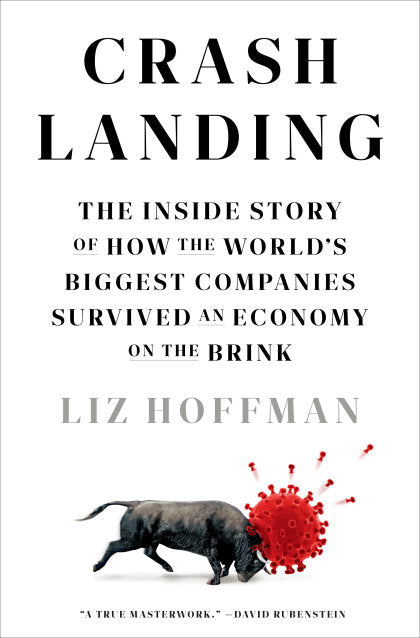
It was the ultimate test for CEOs, and almost none of them saw it coming. In early March 2020, with the Dow Jones flirting with 30,000, the world’s biggest companies were riding an eleven-year economic high. By the end of the month, millions were out of work, iconic firms were begging for bailouts, and countless small businesses were in freefall. Slick consulting teams and country-club connections were suddenly of little use: Business leaders were fumbling in the dark, tossing out long-term strategy and making decisions on the fly—decisions that, they hoped, might just save them.
In Crash Landing, award-winning business journalist Liz Hoffman shows how the pandemic set the economy on fire—but if you look closely, the tinder was already there. After the global financial crisis in 2008, corporate leaders embraced cheap debt and growth at all costs. Wages flatlined. Millions were pushed into the gig economy. Companies crammed workers into offices, and airlines did the same with planes. Wall Street cheered on this relentless march toward efficiency, overlooking the collateral damage and the risks sowed in the process.
Based on astonishing access inside some of the world’s biggest and most iconic companies, Crash Landing is a kaleidoscopic account of the most remarkable period in modern economic history, revealing—through gripping, fly-on-the-wall reporting—how CEOs battled an economic catastrophe for which there was no playbook: among them, Airbnb’s Brian Chesky, blindsided by a virus in the middle of a high-stakes effort to go public; American Airlines’ Doug Parker, shuttling between K Street and the White House, determined to secure a multibillion-dollar bailout; and Ford’s Jim Hackett, as his assembly lines went from building cars to churning out ventilators.
In the tradition of Too Big to Fail and The Big Short, Crash Landing exposes the fear, grit, and gambles behind the pandemic economy, while probing its implications for the future of work, corporate leadership, and capitalism itself, asking: Will this remarkable time give rise to newfound resilience, or become just another costly mistake to be forgotten?
STANDARD, PRIMARY, DM AND VARIANT COVERS
Standard and Primary covers are widely available through general retailers. They often have higher print runs and can be cheaper, especially during sales.
In contrast, Direct Market (DM) and variant covers are primarily sold in comic shops. DM editions tend to have more limited availability and may be more valuable to collectors.
The main differences lie in artwork style, availability, price, and collector appeal. Ultimately, the choice between standard and variant covers depends on personal preference, budget, and individual collecting goals.
PRODUCT TYPES
Comic book enthusiasts have various formats to choose from when collecting their favorite stories.
Here's a brief overview of the main types:
Omnibus
- Large, hardcover collections
- Usually contain complete runs or extensive story arcs
- Typically 800-1000+ pages
- Higher price point, often €100-€150
Oversized Hardcover (OHC)
- Similar dimensions to omnibus, but thinner
- Collect shorter runs or story arcs
- Usually 300-600 pages
- Priced between €30-€50
Hardcover (HC)
- Standard-sized hardcover books
- Collect 6-12 issues typically
- Similar dimensions to single issues, but with a hard cover
- Priced around €25-€35
Trade Paperback (TP)
- Softcover collections
- Standard comic book size
- Usually collect 4-6 issues
- Most affordable option, typically €15-€25
Other Formats
- Absolute Editions: Oversized, deluxe hardcovers (mainly DC Comics)
- Compendiums: Massive paperback collections
- Graphic Novels (OGN/GN): Original stories not previously released as single issues
The choice between these formats often depends on personal preference, budget, and collecting goals. Omnibus and OHC editions offer larger artwork and more content but at a higher price, while TPs provide a more affordable way to collect complete story arcs