

Random House Publishing Group
Creativity, Inc. (The Expanded Edition)
Creativity, Inc. (The Expanded Edition)
Couldn't load pickup availability
Collapsible content
ABOUT
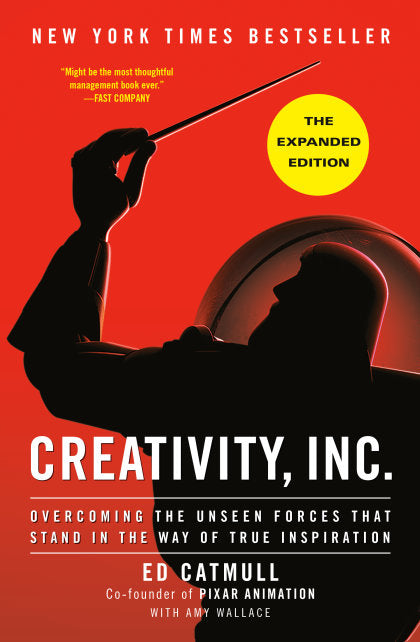
“Might be the most thoughtful management book ever.”—Fast Company
For nearly thirty years, Pixar has dominated the world of animation, producing such beloved films as the Toy Story trilogy, Finding Nemo, The Incredibles, Up, and WALL-E, which have gone on to set box-office records and garner eighteen Academy Awards. The joyous storytelling, the inventive plots, the emotional authenticity: In some ways, Pixar movies are an object lesson in what creativity really is. Here, Catmull reveals the ideals and techniques that have made Pixar so widely admired—and so profitable.
As a young man, Ed Catmull had a dream: to make the first computer-animated movie. He nurtured that dream as a Ph.D. student, and then forged a partnership with George Lucas that led, indirectly, to his founding Pixar with Steve Jobs and John Lasseter in 1986. Nine years later, Toy Story was released, changing animation forever. The essential ingredient in that movie’s success—and in the twenty-five movies that followed—was the unique environment that Catmull and his colleagues built at Pixar, based on philosophies that protect the creative process and defy convention, such as:
• Give a good idea to a mediocre team and they will screw it up. But give a mediocre idea to a great team and they will either fix it or come up with something better.
• It’s not the manager’s job to prevent risks. It’s the manager’s job to make it safe for others to take them.
• The cost of preventing errors is often far greater than the cost of fixing them.
• A company’s communication structure should not mirror its organizational structure. Everybody should be able to talk to anybody.
Creativity, Inc. has been significantly expanded to illuminate the continuing development of the unique culture at Pixar. It features a new introduction, two entirely new chapters, four new chapter postscripts, and changes and updates throughout. Pursuing excellence isn’t a one-off assignment but an ongoing, day-in, day-out, full-time job. And Creativity, Inc. explores how it is done.
STANDARD, PRIMARY, DM AND VARIANT COVERS
Standard and Primary covers are widely available through general retailers. They often have higher print runs and can be cheaper, especially during sales.
In contrast, Direct Market (DM) and variant covers are primarily sold in comic shops. DM editions tend to have more limited availability and may be more valuable to collectors.
The main differences lie in artwork style, availability, price, and collector appeal. Ultimately, the choice between standard and variant covers depends on personal preference, budget, and individual collecting goals.
PRODUCT TYPES
Comic book enthusiasts have various formats to choose from when collecting their favorite stories.
Here's a brief overview of the main types:
Omnibus
- Large, hardcover collections
- Usually contain complete runs or extensive story arcs
- Typically 800-1000+ pages
- Higher price point, often €100-€150
Oversized Hardcover (OHC)
- Similar dimensions to omnibus, but thinner
- Collect shorter runs or story arcs
- Usually 300-600 pages
- Priced between €30-€50
Hardcover (HC)
- Standard-sized hardcover books
- Collect 6-12 issues typically
- Similar dimensions to single issues, but with a hard cover
- Priced around €25-€35
Trade Paperback (TP)
- Softcover collections
- Standard comic book size
- Usually collect 4-6 issues
- Most affordable option, typically €15-€25
Other Formats
- Absolute Editions: Oversized, deluxe hardcovers (mainly DC Comics)
- Compendiums: Massive paperback collections
- Graphic Novels (OGN/GN): Original stories not previously released as single issues
The choice between these formats often depends on personal preference, budget, and collecting goals. Omnibus and OHC editions offer larger artwork and more content but at a higher price, while TPs provide a more affordable way to collect complete story arcs