

Library of America
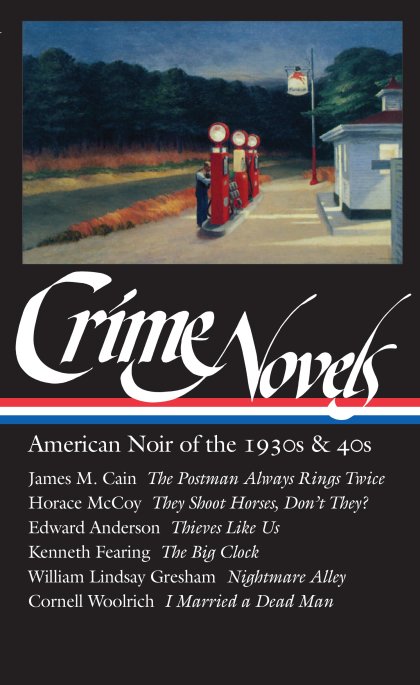
Crime Novels: American Noir of the 1930s & 40s (LOA #94)
Crime Novels: American Noir of the 1930s & 40s (LOA #94)
Couldn't load pickup availability
Collapsible content
ABOUT
Evolving out of the terse and violent style of the pulp magazines, noir fiction expanded over the decades into a varied, innovative and profoundly influential body of writing. The eleven novels in The Library of America’s adventurous two-volume collection taps deep roots in the American literary imagination, exploring themes of crime, guilt, deception, obsessive passion, murder, and the disintegrating psyche. With visionary and often subversive force they create a dark and violent mythology out of the most commonplace elements of modern life.
James M. Cain’s pioneering novel of murder and adultery along the California highway, The Postman Always Rings Twice (1934), shocked contemporaries with its laconic toughness and fierce sexuality.
Horace McCoy’s They Shoot Horses, Don’t They? (1935) uses truncated rhythms and a unique narrative structure to turn its account of a Hollywood dance marathon into an unforgettable evocation of social chaos and personal desperation.
In Thieves Like Us (1937), Edward Anderson vividly brings to life the dusty roads and back-country hideouts where a fugitive band of Oklahoma outlaws plays out its destiny.
The Big Clock (1946), an ingenious novel of pursuit and evasion by the poet Kenneth Fearing, is set by contrast in the dense and neurotic inner world of a giant publishing corporation under the thumb of a warped and ultimately murderous chief executive.
William Lindsay Gresham’s controversial Nightmare Alley (1946), a ferocious psychological portrait of a charismatic carnival hustler, creates an unforgettable atmosphere of duplicity, corruption, and self-destruction.
I Married a Dead Man (1948), a tale of switched identity set in the anxious suburbs, is perhaps the most striking novel of Cornell Woolrich, who found in the techniques of the gothic thriller the means to express an overpowering sense of personal doom.
Disturbing, poetic, anarchic, punctuated by terrifying bursts of rage and paranoia and powerfully evocative of the lost and desperate sidestreets of American life, these are underground classics now made widely and permanently available.
LIBRARY OF AMERICA is an independent nonprofit cultural organization founded in 1979 to preserve our nation’s literary heritage by publishing, and keeping permanently in print, America’s best and most significant writing. The Library of America series includes more than 300 volumes to date, authoritative editions that average 1,000 pages in length, feature cloth covers, sewn bindings, and ribbon markers, and are printed on premium acid-free paper that will last for centuries.
STANDARD, PRIMARY, DM AND VARIANT COVERS
Standard and Primary covers are widely available through general retailers. They often have higher print runs and can be cheaper, especially during sales.
In contrast, Direct Market (DM) and variant covers are primarily sold in comic shops. DM editions tend to have more limited availability and may be more valuable to collectors.
The main differences lie in artwork style, availability, price, and collector appeal. Ultimately, the choice between standard and variant covers depends on personal preference, budget, and individual collecting goals.
PRODUCT TYPES
Comic book enthusiasts have various formats to choose from when collecting their favorite stories.
Here's a brief overview of the main types:
Omnibus
- Large, hardcover collections
- Usually contain complete runs or extensive story arcs
- Typically 800-1000+ pages
- Higher price point, often €100-€150
Oversized Hardcover (OHC)
- Similar dimensions to omnibus, but thinner
- Collect shorter runs or story arcs
- Usually 300-600 pages
- Priced between €30-€50
Hardcover (HC)
- Standard-sized hardcover books
- Collect 6-12 issues typically
- Similar dimensions to single issues, but with a hard cover
- Priced around €25-€35
Trade Paperback (TP)
- Softcover collections
- Standard comic book size
- Usually collect 4-6 issues
- Most affordable option, typically €15-€25
Other Formats
- Absolute Editions: Oversized, deluxe hardcovers (mainly DC Comics)
- Compendiums: Massive paperback collections
- Graphic Novels (OGN/GN): Original stories not previously released as single issues
The choice between these formats often depends on personal preference, budget, and collecting goals. Omnibus and OHC editions offer larger artwork and more content but at a higher price, while TPs provide a more affordable way to collect complete story arcs