

Random House Publishing Group
Daisy Fay and the Miracle Man
Daisy Fay and the Miracle Man
Couldn't load pickup availability
Collapsible content
ABOUT
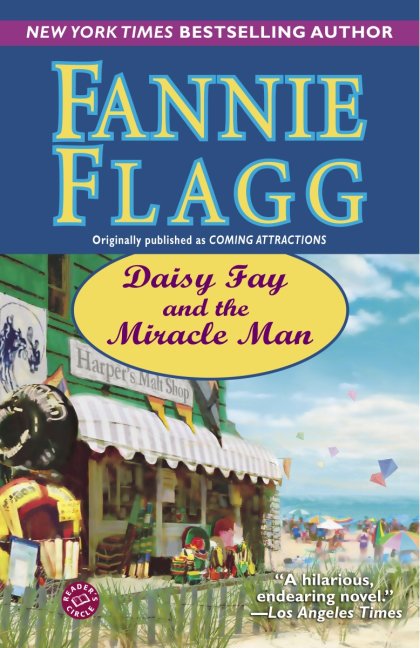
In Fannie Flagg’s high-spirited first novel, we meet Daisy Fay Harper in the spring of 1952, where she’s “not doing much except sitting around waiting for the sixth grade.” When she leaves Shell Beach, Mississippi, in September 1959, she is packed up and ready for the Miss America Pageant, vowing “I won’t come back until I’m somebody.” But in our hearts she already is.
Sassy and irreverent from the get-go, Daisy Fay takes us on a rollicking journey through her formative years on the Gulf Coast of Mississippi. There, at The End of the Road of the South, the family malt shop freezer holds unspeakable things, society maven Mrs. Dot hosts Junior Debutante meetings and shares inspired thoughts for the week (such as “sincerity is as valuable as radium”), and Daisy Fay’s Daddy hatches a quick-cash scheme that involves resurrecting his daughter from the dead in a carefully orchestrated miracle. Along the way, Daisy Fay does a lot of growing up, emerging as one of the most hilarious, appealing, and prized characters in modern fiction.
Praise for Daisy Fay and the Miracle Man
“Sheer unbeatable entertainment.”—Cosmopolitan
“Unforgettable and irresistible.”—Chattanooga Free Press
“Side-splittingly funny.”—Cleveland Plain Dealer
STANDARD, PRIMARY, DM AND VARIANT COVERS
Standard and Primary covers are widely available through general retailers. They often have higher print runs and can be cheaper, especially during sales.
In contrast, Direct Market (DM) and variant covers are primarily sold in comic shops. DM editions tend to have more limited availability and may be more valuable to collectors.
The main differences lie in artwork style, availability, price, and collector appeal. Ultimately, the choice between standard and variant covers depends on personal preference, budget, and individual collecting goals.
PRODUCT TYPES
Comic book enthusiasts have various formats to choose from when collecting their favorite stories.
Here's a brief overview of the main types:
Omnibus
- Large, hardcover collections
- Usually contain complete runs or extensive story arcs
- Typically 800-1000+ pages
- Higher price point, often €100-€150
Oversized Hardcover (OHC)
- Similar dimensions to omnibus, but thinner
- Collect shorter runs or story arcs
- Usually 300-600 pages
- Priced between €30-€50
Hardcover (HC)
- Standard-sized hardcover books
- Collect 6-12 issues typically
- Similar dimensions to single issues, but with a hard cover
- Priced around €25-€35
Trade Paperback (TP)
- Softcover collections
- Standard comic book size
- Usually collect 4-6 issues
- Most affordable option, typically €15-€25
Other Formats
- Absolute Editions: Oversized, deluxe hardcovers (mainly DC Comics)
- Compendiums: Massive paperback collections
- Graphic Novels (OGN/GN): Original stories not previously released as single issues
The choice between these formats often depends on personal preference, budget, and collecting goals. Omnibus and OHC editions offer larger artwork and more content but at a higher price, while TPs provide a more affordable way to collect complete story arcs