

Random House Publishing Group
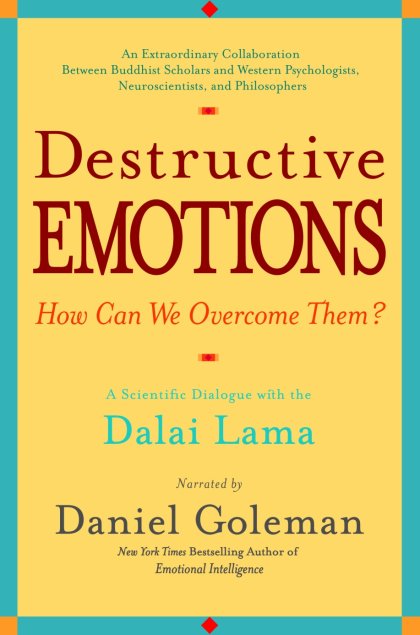
Destructive Emotions
Destructive Emotions
Couldn't load pickup availability
Collapsible content
ABOUT
*What are the root causes of destructive behavior?
*How can we control the emotions that drive these impulses?
*Can we learn to live at peace with ourselves and others?
Imagine sitting with the Dalai Lama in his private meeting room with a small group of world-class scientists and philosophers. The talk is lively and fascinating as these leading minds grapple with age-old questions of compelling contemporary urgency. Daniel Goleman, the internationally bestselling author of Emotional Intelligence, provides the illuminating commentary—and reports on the breakthrough research this historic gathering inspired.
Destructive Emotions
Buddhist philosophy tells us that all personal unhappiness and interpersonal conflict lie in the “three poisons”: craving, anger, and delusion. It also provides antidotes of astonishing psychological sophistication--which are now being confirmed by modern neuroscience. With new high-tech devices, scientists can peer inside the brain centers that calm the inner storms of rage and fear. They also can demonstrate that awareness-training strategies such as meditation strengthen emotional stability—and greatly enhance our positive moods.
The distinguished panel members report these recent findings and debate an exhilarating range of other topics: What role do destructive emotions play in human evolution? Are they “hardwired” in our bodies? Are they universal, or does culture determine how we feel? How can we nurture the compassion that is also our birthright? We learn how practices that reduce negativity have also been shown to bolster the immune system. Here, too, is an enlightened proposal for a school-based program of social and emotional learning that can help our children increase self-awareness, manage their anger, and become more empathetic.
Throughout, these provocative ideas are brought to life by the play of personalities, by the Dalai Lama’s probing questions, and by his surprising sense of humor. Although there are no easy answers, the dialogues, which are part of a series sponsored by the Mind and Life Institute, chart an ultimately hopeful course. They are sure to spark discussion among educators, religious and political leaders, parents—and all people who seek peace for themselves and the world.
The Mind and Life Institute sponsors cross-cultural dialogues that bring together the Dalai Lama and other Buddhist scholars with Western scientists and philosophers. Mind and Life VIII, on which this book is based, took place in Dharamsala, India, in March 2000.
STANDARD, PRIMARY, DM AND VARIANT COVERS
Standard and Primary covers are widely available through general retailers. They often have higher print runs and can be cheaper, especially during sales.
In contrast, Direct Market (DM) and variant covers are primarily sold in comic shops. DM editions tend to have more limited availability and may be more valuable to collectors.
The main differences lie in artwork style, availability, price, and collector appeal. Ultimately, the choice between standard and variant covers depends on personal preference, budget, and individual collecting goals.
PRODUCT TYPES
Comic book enthusiasts have various formats to choose from when collecting their favorite stories.
Here's a brief overview of the main types:
Omnibus
- Large, hardcover collections
- Usually contain complete runs or extensive story arcs
- Typically 800-1000+ pages
- Higher price point, often €100-€150
Oversized Hardcover (OHC)
- Similar dimensions to omnibus, but thinner
- Collect shorter runs or story arcs
- Usually 300-600 pages
- Priced between €30-€50
Hardcover (HC)
- Standard-sized hardcover books
- Collect 6-12 issues typically
- Similar dimensions to single issues, but with a hard cover
- Priced around €25-€35
Trade Paperback (TP)
- Softcover collections
- Standard comic book size
- Usually collect 4-6 issues
- Most affordable option, typically €15-€25
Other Formats
- Absolute Editions: Oversized, deluxe hardcovers (mainly DC Comics)
- Compendiums: Massive paperback collections
- Graphic Novels (OGN/GN): Original stories not previously released as single issues
The choice between these formats often depends on personal preference, budget, and collecting goals. Omnibus and OHC editions offer larger artwork and more content but at a higher price, while TPs provide a more affordable way to collect complete story arcs