

Penguin Publishing Group
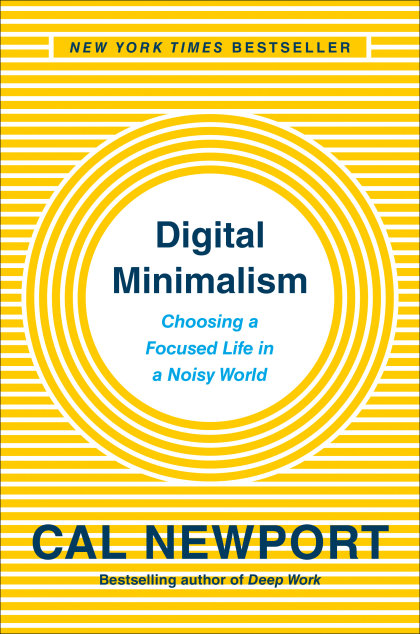
Digital Minimalism
Digital Minimalism
Couldn't load pickup availability
Collapsible content
ABOUT
"Newport is making a bid to be the Marie Kondo of technology: someone with an actual plan for helping you realize the digital pursuits that do, and don't, bring value to your life."--Ezra Klein, Vox
Minimalism is the art of knowing how much is just enough. Digital minimalism applies this idea to our personal technology. It's the key to living a focused life in an increasingly noisy world.
In this timely and enlightening book, the bestselling author of Deep Work introduces a philosophy for technology use that has already improved countless lives.
Digital minimalists are all around us. They're the calm, happy people who can hold long conversations without furtive glances at their phones. They can get lost in a good book, a woodworking project, or a leisurely morning run. They can have fun with friends and family without the obsessive urge to document the experience. They stay informed about the news of the day, but don't feel overwhelmed by it. They don't experience "fear of missing out" because they already know which activities provide them meaning and satisfaction.
Now, Newport gives us a name for this quiet movement, and makes a persuasive case for its urgency in our tech-saturated world. Common sense tips, like turning off notifications, or occasional rituals like observing a digital sabbath, don't go far enough in helping us take back control of our technological lives, and attempts to unplug completely are complicated by the demands of family, friends and work. What we need instead is a thoughtful method to decide what tools to use, for what purposes, and under what conditions.
Drawing on a diverse array of real-life examples, from Amish farmers to harried parents to Silicon Valley programmers, Newport identifies the common practices of digital minimalists and the ideas that underpin them. He shows how digital minimalists are rethinking their relationship to social media, rediscovering the pleasures of the offline world, and reconnecting with their inner selves through regular periods of solitude. He then shares strategies for integrating these practices into your life, starting with a thirty-day "digital declutter" process that has already helped thousands feel less overwhelmed and more in control.
Technology is intrinsically neither good nor bad. The key is using it to support your goals and values, rather than letting it use you. This book shows the way.
STANDARD, PRIMARY, DM AND VARIANT COVERS
Standard and Primary covers are widely available through general retailers. They often have higher print runs and can be cheaper, especially during sales.
In contrast, Direct Market (DM) and variant covers are primarily sold in comic shops. DM editions tend to have more limited availability and may be more valuable to collectors.
The main differences lie in artwork style, availability, price, and collector appeal. Ultimately, the choice between standard and variant covers depends on personal preference, budget, and individual collecting goals.
PRODUCT TYPES
Comic book enthusiasts have various formats to choose from when collecting their favorite stories.
Here's a brief overview of the main types:
Omnibus
- Large, hardcover collections
- Usually contain complete runs or extensive story arcs
- Typically 800-1000+ pages
- Higher price point, often €100-€150
Oversized Hardcover (OHC)
- Similar dimensions to omnibus, but thinner
- Collect shorter runs or story arcs
- Usually 300-600 pages
- Priced between €30-€50
Hardcover (HC)
- Standard-sized hardcover books
- Collect 6-12 issues typically
- Similar dimensions to single issues, but with a hard cover
- Priced around €25-€35
Trade Paperback (TP)
- Softcover collections
- Standard comic book size
- Usually collect 4-6 issues
- Most affordable option, typically €15-€25
Other Formats
- Absolute Editions: Oversized, deluxe hardcovers (mainly DC Comics)
- Compendiums: Massive paperback collections
- Graphic Novels (OGN/GN): Original stories not previously released as single issues
The choice between these formats often depends on personal preference, budget, and collecting goals. Omnibus and OHC editions offer larger artwork and more content but at a higher price, while TPs provide a more affordable way to collect complete story arcs