

Catapult
Distant Neighbors
Distant Neighbors
Couldn't load pickup availability
Collapsible content
ABOUT
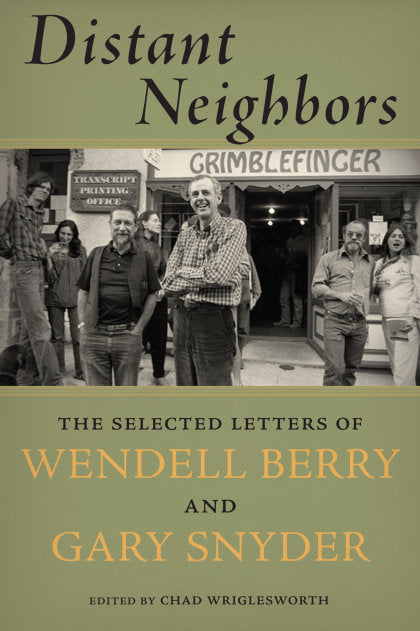
In 1969 Gary Snyder returned from a long residence in Japan to northern California, to a homestead in the Sierra foothills where he intended to build a house and settle on the land with his wife and young sons. He had just published his first book of essays, Earth House Hold. A few years before, after a long absence, Wendell Berry left New York City to return to land near his grandfather's farm in Port Royal, Kentucky, where he built a small studio and lived there with his wife as they restored an old house on their newly acquired homestead. In 1969 Berry had just published Long–Legged House. These two founding members of the counterculture and of the new environmental movement had yet to meet, but they knew each other's work, and soon they began a correspondence. Neither man could have imagined the impact their work would have on American political and literary culture, nor could they have appreciated the impact they would have on one another.
Snyder had thrown over all vestiges of Christianity in favor of becoming a devoted Buddhist and Zen practitioner, and had lived in Japan for a prolonged period to develop this practice. Berry's discomfort with the Christianity of his native land caused him to become something of a renegade Christian, troubled by the church and organized religion, but grounded in its vocabulary and its narrative. Religion and spirituality seemed like a natural topic for the two men to discuss, and discuss they did. They exchanged more than 240 letters from 1973 to 2013, remarkable letters of insight and argument. The two bring out the best in each other, as they grapple with issues of faith and reason, discuss ideas of home and family, worry over the disintegration of community and commonwealth, and share the details of the lives they've chosen to live with their wives and children. Contemporary American culture is the landscape they reside on. Environmentalism, sustainability, global politics and American involvement, literature, poetry and progressive ideals, these two public intellectuals address issues as broad as are found in any exchange in literature.
No one can be unaffected by the complexity of their relationship, the subtlety of their arguments, and the grace of their friendship. This is a book for the ages.
"In Distant Neighbors, both Berry and Snyder come across as honest and open–hearted explorers. There is an overall sense that they possess a deep and questing wisdom, hard earned through land work, travel, writing, and spiritual exploration. There is no rushing, no hectoring, and no grand gestures between these two, just an ever–deepening inquiry into what makes a good life and how to live it, even in the depths of the machine age." —Orion
STANDARD, PRIMARY, DM AND VARIANT COVERS
Standard and Primary covers are widely available through general retailers. They often have higher print runs and can be cheaper, especially during sales.
In contrast, Direct Market (DM) and variant covers are primarily sold in comic shops. DM editions tend to have more limited availability and may be more valuable to collectors.
The main differences lie in artwork style, availability, price, and collector appeal. Ultimately, the choice between standard and variant covers depends on personal preference, budget, and individual collecting goals.
PRODUCT TYPES
Comic book enthusiasts have various formats to choose from when collecting their favorite stories.
Here's a brief overview of the main types:
Omnibus
- Large, hardcover collections
- Usually contain complete runs or extensive story arcs
- Typically 800-1000+ pages
- Higher price point, often €100-€150
Oversized Hardcover (OHC)
- Similar dimensions to omnibus, but thinner
- Collect shorter runs or story arcs
- Usually 300-600 pages
- Priced between €30-€50
Hardcover (HC)
- Standard-sized hardcover books
- Collect 6-12 issues typically
- Similar dimensions to single issues, but with a hard cover
- Priced around €25-€35
Trade Paperback (TP)
- Softcover collections
- Standard comic book size
- Usually collect 4-6 issues
- Most affordable option, typically €15-€25
Other Formats
- Absolute Editions: Oversized, deluxe hardcovers (mainly DC Comics)
- Compendiums: Massive paperback collections
- Graphic Novels (OGN/GN): Original stories not previously released as single issues
The choice between these formats often depends on personal preference, budget, and collecting goals. Omnibus and OHC editions offer larger artwork and more content but at a higher price, while TPs provide a more affordable way to collect complete story arcs