

Knopf Doubleday Publishing Group
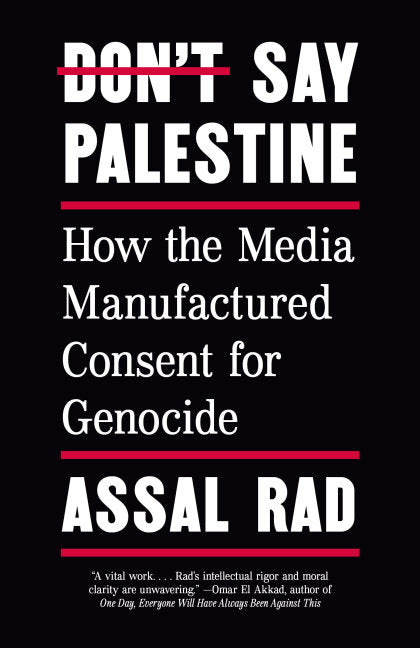
Don't Say Palestine
Don't Say Palestine
Couldn't load pickup availability
Collapsible content
ABOUT
"In this important new work of media criticism, Rad dissects the biases, distortions, and falsehoods by which press institutions conceal the atrocities of empire—as well as delivering a powerful call for accountability, justice, and truth." —Molly Crabapple, author of Here Where We Live Is Our Country
If you’re not writing the truth about crimes against humanity, you’re culpable in them.
Activist and Middle East historian Assal Rad is known as the “headline fixer” for her powerful posts that illustrate how mainstream Western media’s coverage of the Gaza Genocide is filled with double standards. Israelis are described as "children" and "civilians," while Palestinians are "people under 18" and "collateral damage"; Israelis are killed; Palestinians die. Even in the wake of the so-called ceasefire, major Western media continually obfuscates Israeli violence in Palestine: For example, the Associated Press reported that "Gaza's living conditions worsen as strong winds and hypothermia kill 5." No, Rad corrects: Gaza's living conditions worsen as Israel blocks aid.
In Don’t Say Palestine, Rad reveals a pattern of dehumanizing language—in outlets from CNN and the AP to the BBC and The New York Times—so consistently employed throughout the Palestinian genocide that it amounts to a policy. Mainstream Western media consistently downplays Israeli responsibility, “others” Palestinians, and casts doubt on inviolable tenets of international law like the sanctity of hospitals and journalists in war zones. This groundbreaking, eye-opening exposé offers both a moral reckoning and an urgent call to action, mapping with devastating clarity the media’s complicity in whitewashing a human rights crisis.
STANDARD, PRIMARY, DM AND VARIANT COVERS
Standard and Primary covers are widely available through general retailers. They often have higher print runs and can be cheaper, especially during sales.
In contrast, Direct Market (DM) and variant covers are primarily sold in comic shops. DM editions tend to have more limited availability and may be more valuable to collectors.
The main differences lie in artwork style, availability, price, and collector appeal. Ultimately, the choice between standard and variant covers depends on personal preference, budget, and individual collecting goals.
PRODUCT TYPES
Comic book enthusiasts have various formats to choose from when collecting their favorite stories.
Here's a brief overview of the main types:
Omnibus
- Large, hardcover collections
- Usually contain complete runs or extensive story arcs
- Typically 800-1000+ pages
- Higher price point, often €100-€150
Oversized Hardcover (OHC)
- Similar dimensions to omnibus, but thinner
- Collect shorter runs or story arcs
- Usually 300-600 pages
- Priced between €30-€50
Hardcover (HC)
- Standard-sized hardcover books
- Collect 6-12 issues typically
- Similar dimensions to single issues, but with a hard cover
- Priced around €25-€35
Trade Paperback (TP)
- Softcover collections
- Standard comic book size
- Usually collect 4-6 issues
- Most affordable option, typically €15-€25
Other Formats
- Absolute Editions: Oversized, deluxe hardcovers (mainly DC Comics)
- Compendiums: Massive paperback collections
- Graphic Novels (OGN/GN): Original stories not previously released as single issues
The choice between these formats often depends on personal preference, budget, and collecting goals. Omnibus and OHC editions offer larger artwork and more content but at a higher price, while TPs provide a more affordable way to collect complete story arcs