

Clarkson Potter/Ten Speed
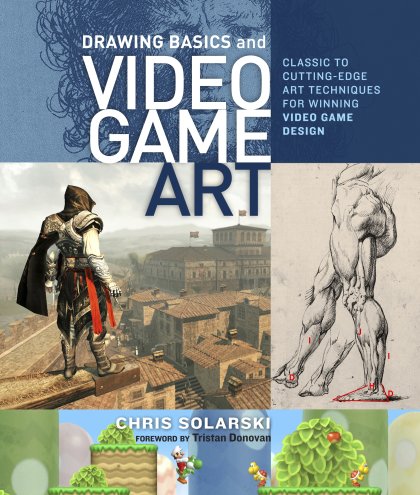
Drawing Basics and Video Game Art
Drawing Basics and Video Game Art
Couldn't load pickup availability
Collapsible content
ABOUT
— John Romero, co-founder of id Software and CEO of Loot Drop, Inc.
"Solarski’s methodology here is to show us the artistic techniques that every artist should know, and then he transposes them to the realm of video games to show how they should be used to create a far more artful gaming experience ... if I were an artist planning to do video game work, I’d have a copy of this on my shelf."
— Marc Mason, Comics Waiting Room
Video games are not a revolution in art history, but an evolution. Whether the medium is paper or canvas—or a computer screen—the artist’s challenge is to make something without depth seem like a window into a living, breathing world. Video game art is no different.
Drawing Basics and Video Game Art is first to examine the connections between classical art and video games, enabling developers to create more expressive and varied emotional experiences in games. Artist game designer Chris Solarski gives readers a comprehensive introduction to basic and advanced drawing and design skills—light, value, color, anatomy, concept development—as well as detailed instruction for using these methods to design complex characters, worlds, and gameplay experiences. Artwork by the likes of Michelangelo, Titian, and Rubens are studied alongside AAA games like BioShock, Journey, the Mario series, and Portal 2, to demonstrate perpetual theories of depth, composition, movement, artistic anatomy, and expression.
Although Drawing Basics and Video Game Art is primarily a practical reference for artists and designers working in the video games industry, it’s equally accessible for those interested to learn about gaming’s future, and potential as an artistic medium.
Also available as an eBook
STANDARD, PRIMARY, DM AND VARIANT COVERS
Standard and Primary covers are widely available through general retailers. They often have higher print runs and can be cheaper, especially during sales.
In contrast, Direct Market (DM) and variant covers are primarily sold in comic shops. DM editions tend to have more limited availability and may be more valuable to collectors.
The main differences lie in artwork style, availability, price, and collector appeal. Ultimately, the choice between standard and variant covers depends on personal preference, budget, and individual collecting goals.
PRODUCT TYPES
Comic book enthusiasts have various formats to choose from when collecting their favorite stories.
Here's a brief overview of the main types:
Omnibus
- Large, hardcover collections
- Usually contain complete runs or extensive story arcs
- Typically 800-1000+ pages
- Higher price point, often €100-€150
Oversized Hardcover (OHC)
- Similar dimensions to omnibus, but thinner
- Collect shorter runs or story arcs
- Usually 300-600 pages
- Priced between €30-€50
Hardcover (HC)
- Standard-sized hardcover books
- Collect 6-12 issues typically
- Similar dimensions to single issues, but with a hard cover
- Priced around €25-€35
Trade Paperback (TP)
- Softcover collections
- Standard comic book size
- Usually collect 4-6 issues
- Most affordable option, typically €15-€25
Other Formats
- Absolute Editions: Oversized, deluxe hardcovers (mainly DC Comics)
- Compendiums: Massive paperback collections
- Graphic Novels (OGN/GN): Original stories not previously released as single issues
The choice between these formats often depends on personal preference, budget, and collecting goals. Omnibus and OHC editions offer larger artwork and more content but at a higher price, while TPs provide a more affordable way to collect complete story arcs