

Penguin Publishing Group
Driving Honda
Driving Honda
Couldn't load pickup availability
Collapsible content
ABOUT
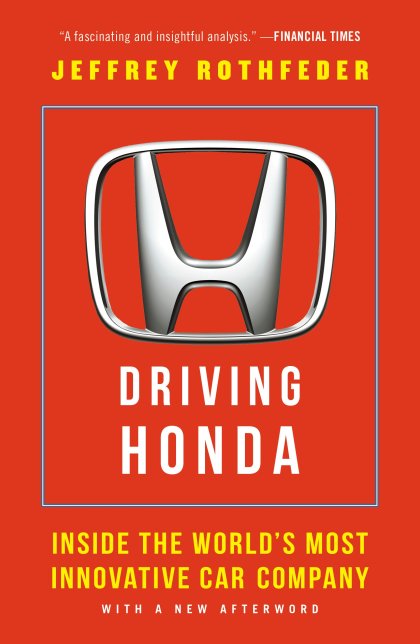
Since its birth as a motorcycle company in 1949, Honda has steadily grown into one of the world’s largest automakers and engine manufacturers, as well as one of the most beloved, most profitable, and most consistently innovative multinational corporations. What drives the company that keeps creating and improving award-winning and bestselling models like the Civic, Accord, Odyssey, CR-V, and Pilot?
According to Jeffrey Rothfeder, what truly distinguishes Honda from its competitors, especially archrival Toyota, is a deep commitment to a set of unorthodox management tenets. The Honda Way, as insiders call it, is notable for decentralization over corporate control, simplicity over complexity, experimentation over Six Sigma–driven efficiency, and unyielding cynicism toward the status quo and whatever is assumed to be the truth. Those are just a few of the ideas that the company’s colorful founder Soichiro Honda embedded in the DNA of his start-up sixty-five years ago.
As the first journalist allowed behind Honda’s infamously private doors, Rothfeder interviewed dozens of executives, engineers, and frontline employees about Honda’s management practices and global strategy. He shows how the company developed and maintained its unmatched culture of innovation, resilience, and flexibility—and how it exported that culture to other countries that are strikingly different from Japan, establishing locally controlled operations in each region where it lays down roots.
STANDARD, PRIMARY, DM AND VARIANT COVERS
Standard and Primary covers are widely available through general retailers. They often have higher print runs and can be cheaper, especially during sales.
In contrast, Direct Market (DM) and variant covers are primarily sold in comic shops. DM editions tend to have more limited availability and may be more valuable to collectors.
The main differences lie in artwork style, availability, price, and collector appeal. Ultimately, the choice between standard and variant covers depends on personal preference, budget, and individual collecting goals.
PRODUCT TYPES
Comic book enthusiasts have various formats to choose from when collecting their favorite stories.
Here's a brief overview of the main types:
Omnibus
- Large, hardcover collections
- Usually contain complete runs or extensive story arcs
- Typically 800-1000+ pages
- Higher price point, often €100-€150
Oversized Hardcover (OHC)
- Similar dimensions to omnibus, but thinner
- Collect shorter runs or story arcs
- Usually 300-600 pages
- Priced between €30-€50
Hardcover (HC)
- Standard-sized hardcover books
- Collect 6-12 issues typically
- Similar dimensions to single issues, but with a hard cover
- Priced around €25-€35
Trade Paperback (TP)
- Softcover collections
- Standard comic book size
- Usually collect 4-6 issues
- Most affordable option, typically €15-€25
Other Formats
- Absolute Editions: Oversized, deluxe hardcovers (mainly DC Comics)
- Compendiums: Massive paperback collections
- Graphic Novels (OGN/GN): Original stories not previously released as single issues
The choice between these formats often depends on personal preference, budget, and collecting goals. Omnibus and OHC editions offer larger artwork and more content but at a higher price, while TPs provide a more affordable way to collect complete story arcs