

Knopf Doubleday Publishing Group
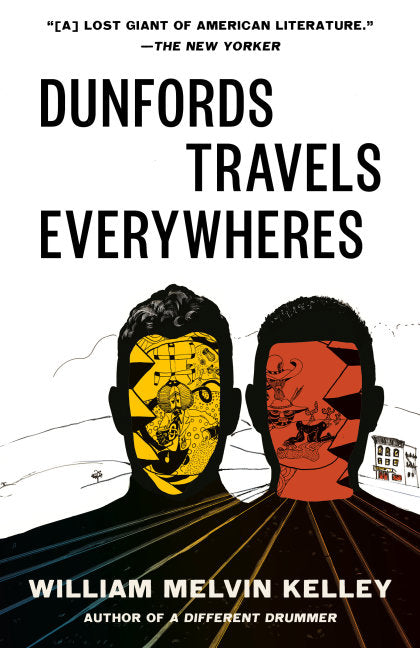
Dunfords Travels Everywheres
Dunfords Travels Everywheres
Couldn't load pickup availability
Collapsible content
ABOUT
"[A] lost giant of American Literature." —The New Yorker
Ride on out with Rab and Turt, two o'New Afriqueque's toughfast, ruefast Texnosass Arangers, as they battle Chief Pugmichillo and ricecure Mr. Charcarl Walker-Rider. Cut in on Carlyle Bedlowe, wrecker of marriage, saver of souls.
Or just along with Chig Dunford, product of Harlem and private schools, on the circular voyage of self-discovery that takes him from Europe's Café of One Hand to Harlem's Jack O'Gee's Golden Grouse Bar & Restaurant.
Beginning on an August Sunday in one of Europe's strangest cities, Dunfords Travels Everywheres but always returns back to the same point—the "Begending"—where Mr. Charcarl's dream becomes Chig Dunford's reality (the "Ivy League Negro" in the world outside the Ivory Tower).
“Among the most innovative and exciting novelists in the history of international literature, the opportunity to honor William Melvin Kelley with the American Book Award is a great privilege. Before Columbus Foundation is elated to welcome his work back into print, thanks to Anchor Books. It is a unique thrill to see Dunfords Travels Everywheres now illustrated in it’s new edition by Aiki Kelley, whom we also honor with this year’s Award. The majesty of William Melvin Kelley’s vital contribution to international letters remains urgent and evermore medicinal in its cosmic scope and unifying embrace. The total arc and panorama of human experience, embodied in the mythologies we share from antiquity to the present are fully illuminated in William Melvin Kelley’s artistry. An absolute virtuoso of the language, with Dunfords Travels Everywheres, William Melvin Kelley ignites the spiritual imagination, reviving and resuscitating images of our journey with wit and grace. His masterwork is truly a wonder to behold. Vivid, charismatic, mercurial, musical, Dunfords Travels Everywheres stands as one of the great contributions to the art of the novel. Laughing to keep from crying, living life not dying, this new illustrated edition sings a joyous, uplifitng song.” —Justin Desmangles, citation from the American Book Award
STANDARD, PRIMARY, DM AND VARIANT COVERS
Standard and Primary covers are widely available through general retailers. They often have higher print runs and can be cheaper, especially during sales.
In contrast, Direct Market (DM) and variant covers are primarily sold in comic shops. DM editions tend to have more limited availability and may be more valuable to collectors.
The main differences lie in artwork style, availability, price, and collector appeal. Ultimately, the choice between standard and variant covers depends on personal preference, budget, and individual collecting goals.
PRODUCT TYPES
Comic book enthusiasts have various formats to choose from when collecting their favorite stories.
Here's a brief overview of the main types:
Omnibus
- Large, hardcover collections
- Usually contain complete runs or extensive story arcs
- Typically 800-1000+ pages
- Higher price point, often €100-€150
Oversized Hardcover (OHC)
- Similar dimensions to omnibus, but thinner
- Collect shorter runs or story arcs
- Usually 300-600 pages
- Priced between €30-€50
Hardcover (HC)
- Standard-sized hardcover books
- Collect 6-12 issues typically
- Similar dimensions to single issues, but with a hard cover
- Priced around €25-€35
Trade Paperback (TP)
- Softcover collections
- Standard comic book size
- Usually collect 4-6 issues
- Most affordable option, typically €15-€25
Other Formats
- Absolute Editions: Oversized, deluxe hardcovers (mainly DC Comics)
- Compendiums: Massive paperback collections
- Graphic Novels (OGN/GN): Original stories not previously released as single issues
The choice between these formats often depends on personal preference, budget, and collecting goals. Omnibus and OHC editions offer larger artwork and more content but at a higher price, while TPs provide a more affordable way to collect complete story arcs