

Catapult
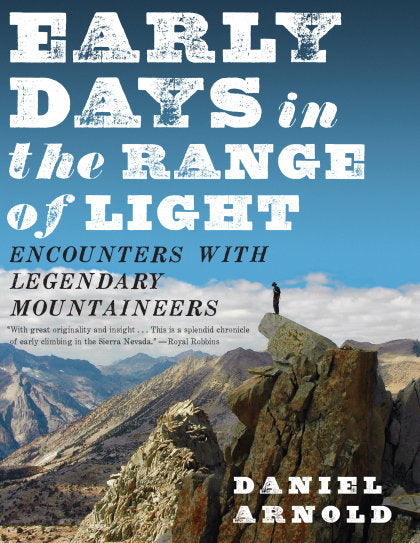
Early Days in the Range of Light
Early Days in the Range of Light
Couldn't load pickup availability
Collapsible content
ABOUT
It’s 1873. Gore–Tex shells and aluminum climbing gear are a century away, but the high mountains still call to those with a spirit of adventure. Imagine the stone in your hands and thousands of feet of open air below you, with only a wool jacket to weather a storm and no rope to catch a fall.
Daniel Arnold did more than imagine—he spent three years retracing the steps of his climbing forefathers, and in Early Days in the Range of Light, he tells their riveting stories. From 1864 to 1931, the Sierra Nevada witnessed some of the most audacious climbing of all time. In the spirit of his predecessors, Arnold carried only rudimentary equipment: no ropes, no harness, no specialized climbing shoes. Sometimes he left his backpack and sleeping bag behind as well, and, like John Muir, traveled for days with only a few pounds of food rolled into a sack slung over his shoulder. In an artful blend of history, biography, nature, and adventure writing, Arnold brings to life the journeys and the terrain traveled. In the process he uncovers the motivations that drove an extraordinary group of individuals to risk so much for airy summits and close contact with bare stone and snow.
“Ever wish you could travel back to climbing’s early days and follow the earliest first–ascent visionaries? This fantasy comes to life . . . in this elegant narrative.” —Climbing Magazine
STANDARD, PRIMARY, DM AND VARIANT COVERS
Standard and Primary covers are widely available through general retailers. They often have higher print runs and can be cheaper, especially during sales.
In contrast, Direct Market (DM) and variant covers are primarily sold in comic shops. DM editions tend to have more limited availability and may be more valuable to collectors.
The main differences lie in artwork style, availability, price, and collector appeal. Ultimately, the choice between standard and variant covers depends on personal preference, budget, and individual collecting goals.
PRODUCT TYPES
Comic book enthusiasts have various formats to choose from when collecting their favorite stories.
Here's a brief overview of the main types:
Omnibus
- Large, hardcover collections
- Usually contain complete runs or extensive story arcs
- Typically 800-1000+ pages
- Higher price point, often €100-€150
Oversized Hardcover (OHC)
- Similar dimensions to omnibus, but thinner
- Collect shorter runs or story arcs
- Usually 300-600 pages
- Priced between €30-€50
Hardcover (HC)
- Standard-sized hardcover books
- Collect 6-12 issues typically
- Similar dimensions to single issues, but with a hard cover
- Priced around €25-€35
Trade Paperback (TP)
- Softcover collections
- Standard comic book size
- Usually collect 4-6 issues
- Most affordable option, typically €15-€25
Other Formats
- Absolute Editions: Oversized, deluxe hardcovers (mainly DC Comics)
- Compendiums: Massive paperback collections
- Graphic Novels (OGN/GN): Original stories not previously released as single issues
The choice between these formats often depends on personal preference, budget, and collecting goals. Omnibus and OHC editions offer larger artwork and more content but at a higher price, while TPs provide a more affordable way to collect complete story arcs