

Random House Publishing Group
Eat the Buddha
Eat the Buddha
Couldn't load pickup availability
Collapsible content
ABOUT
“A brilliantly reported and eye-opening work of narrative nonfiction.”—The New York Times Book Review
NAMED ONE OF THE BEST BOOKS OF THE YEAR BY Parul Sehgal, The New York Times • The New York Times Book Review • The Washington Post • NPR • The Economist • Outside • Foreign Affairs
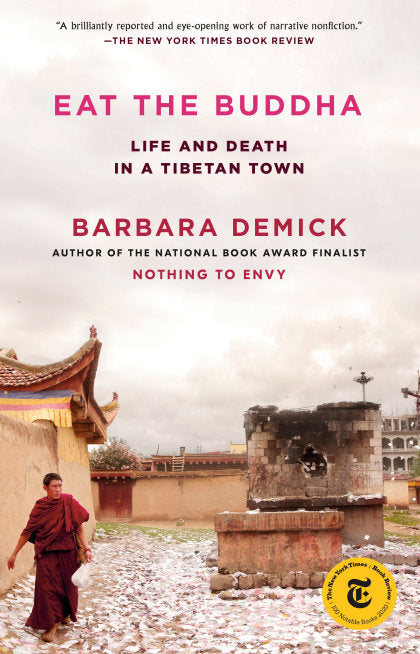
Just as she did with North Korea, award-winning journalist Barbara Demick explores one of the most hidden corners of the world. She tells the story of a Tibetan town perched eleven thousand feet above sea level that is one of the most difficult places in all of China for foreigners to visit. Ngaba was one of the first places where the Tibetans and the Chinese Communists encountered one another. In the 1930s, Mao Zedong’s Red Army fled into the Tibetan plateau to escape their adversaries in the Chinese Civil War. By the time the soldiers reached Ngaba, they were so hungry that they looted monasteries and ate religious statues made of flour and butter—to Tibetans, it was as if they were eating the Buddha. Their experiences would make Ngaba one of the engines of Tibetan resistance for decades to come, culminating in shocking acts of self-immolation.
Eat the Buddha spans decades of modern Tibetan and Chinese history, as told through the private lives of Demick’s subjects, among them a princess whose family is wiped out during the Cultural Revolution, a young Tibetan nomad who becomes radicalized in the storied monastery of Kirti, an upwardly mobile entrepreneur who falls in love with a Chinese woman, a poet and intellectual who risks everything to voice his resistance, and a Tibetan schoolgirl forced to choose at an early age between her family and the elusive lure of Chinese money. All of them face the same dilemma: Do they resist the Chinese, or do they join them? Do they adhere to Buddhist teachings of compassion and nonviolence, or do they fight?
Illuminating a culture that has long been romanticized by Westerners as deeply spiritual and peaceful, Demick reveals what it is really like to be a Tibetan in the twenty-first century, trying to preserve one’s culture, faith, and language against the depredations of a seemingly unstoppable, technologically all-seeing superpower. Her depiction is nuanced, unvarnished, and at times shocking.
STANDARD, PRIMARY, DM AND VARIANT COVERS
Standard and Primary covers are widely available through general retailers. They often have higher print runs and can be cheaper, especially during sales.
In contrast, Direct Market (DM) and variant covers are primarily sold in comic shops. DM editions tend to have more limited availability and may be more valuable to collectors.
The main differences lie in artwork style, availability, price, and collector appeal. Ultimately, the choice between standard and variant covers depends on personal preference, budget, and individual collecting goals.
PRODUCT TYPES
Comic book enthusiasts have various formats to choose from when collecting their favorite stories.
Here's a brief overview of the main types:
Omnibus
- Large, hardcover collections
- Usually contain complete runs or extensive story arcs
- Typically 800-1000+ pages
- Higher price point, often €100-€150
Oversized Hardcover (OHC)
- Similar dimensions to omnibus, but thinner
- Collect shorter runs or story arcs
- Usually 300-600 pages
- Priced between €30-€50
Hardcover (HC)
- Standard-sized hardcover books
- Collect 6-12 issues typically
- Similar dimensions to single issues, but with a hard cover
- Priced around €25-€35
Trade Paperback (TP)
- Softcover collections
- Standard comic book size
- Usually collect 4-6 issues
- Most affordable option, typically €15-€25
Other Formats
- Absolute Editions: Oversized, deluxe hardcovers (mainly DC Comics)
- Compendiums: Massive paperback collections
- Graphic Novels (OGN/GN): Original stories not previously released as single issues
The choice between these formats often depends on personal preference, budget, and collecting goals. Omnibus and OHC editions offer larger artwork and more content but at a higher price, while TPs provide a more affordable way to collect complete story arcs