

Penguin Publishing Group
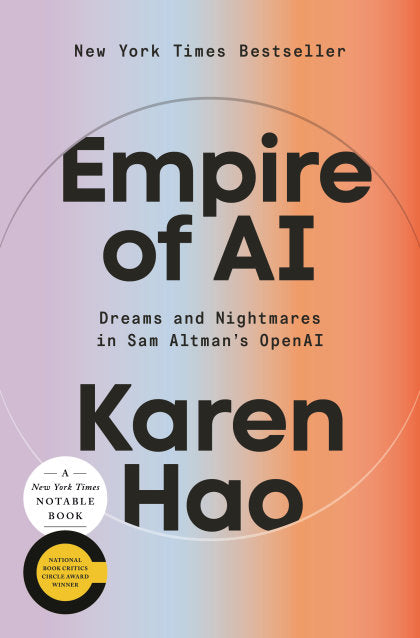
Empire of AI
Empire of AI
Couldn't load pickup availability
Collapsible content
ABOUT
“A bestselling page-turner that has made waves not just in Silicon Valley but around the world . . . With Empire of AI, Hao is fundamentally shaping many people’s perceptions and understanding of the company at the center of the AI revolution.” —TIME Magazine, “TIME100 AI 2025”
“Excellent and deeply reported.” —Tim Wu, The New York Times
“Startling and intensely researched . . . an essential account of how OpenAI and ChatGPT came to be and the catastrophic places they will likely take us.” —Vulture
From a brilliant longtime AI insider with intimate access to the world of Sam Altman's OpenAI from the beginning, an eye-opening account of the tech arms race in history that is reshaping the planet in real time
When AI expert and investigative journalist Karen Hao first began covering OpenAI, she thought they were the good guys. Founded as a nonprofit with safety enshrined, the organization was meant to act as a check against more purely mercantile forces. What could go wrong?
Over time, Hao wrestled with that question. Increasingly, she realized that this disruptive sector’s vision of success requires an unprecedented amount of resources: the “compute” power of high-end chips and the processing capacity to create massive large language models, the sheer volume of data that needs to be amassed at scale, the humans “cleaning up” that data for sweatshop wages throughout the Global South, and a truly alarming spike in the usage of energy and water underlying it all. We have entered a new age of empire where only a handful of globally scaled companies can enter the field of play.
Armed with billions, pushing on trillions, OpenAI is setting a breakneck pace—toward what end, not even they can define. All this time, Hao has maintained deep sourcing within the company and the industry, keeping in intimate contact with the story that shocked the entire tech industry—Altman’s sudden firing and triumphant return. The behind-the-scenes of what happened is revelatory of who the people controlling this technology really are. But this isn’t just the story of a single company. As Hao shows through intrepid global reporting, the enormous wheels of extraction grind on. An astonishing eyewitness view from both the command capsule of the new economy and where the real suffering happens, Empire of AI pierces the veil of the industry defining our era.
STANDARD, PRIMARY, DM AND VARIANT COVERS
Standard and Primary covers are widely available through general retailers. They often have higher print runs and can be cheaper, especially during sales.
In contrast, Direct Market (DM) and variant covers are primarily sold in comic shops. DM editions tend to have more limited availability and may be more valuable to collectors.
The main differences lie in artwork style, availability, price, and collector appeal. Ultimately, the choice between standard and variant covers depends on personal preference, budget, and individual collecting goals.
PRODUCT TYPES
Comic book enthusiasts have various formats to choose from when collecting their favorite stories.
Here's a brief overview of the main types:
Omnibus
- Large, hardcover collections
- Usually contain complete runs or extensive story arcs
- Typically 800-1000+ pages
- Higher price point, often €100-€150
Oversized Hardcover (OHC)
- Similar dimensions to omnibus, but thinner
- Collect shorter runs or story arcs
- Usually 300-600 pages
- Priced between €30-€50
Hardcover (HC)
- Standard-sized hardcover books
- Collect 6-12 issues typically
- Similar dimensions to single issues, but with a hard cover
- Priced around €25-€35
Trade Paperback (TP)
- Softcover collections
- Standard comic book size
- Usually collect 4-6 issues
- Most affordable option, typically €15-€25
Other Formats
- Absolute Editions: Oversized, deluxe hardcovers (mainly DC Comics)
- Compendiums: Massive paperback collections
- Graphic Novels (OGN/GN): Original stories not previously released as single issues
The choice between these formats often depends on personal preference, budget, and collecting goals. Omnibus and OHC editions offer larger artwork and more content but at a higher price, while TPs provide a more affordable way to collect complete story arcs