

Random House Publishing Group
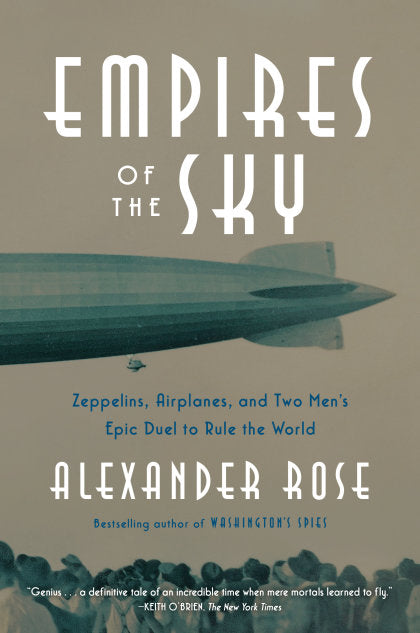
Empires of the Sky
Empires of the Sky
Couldn't load pickup availability
Collapsible content
ABOUT
“Genius . . . a definitive tale of an incredible time when mere mortals learned to fly.”—Keith O’Brien, The New York Times
At the dawn of the twentieth century, when human flight was still considered an impossibility, Germany’s Count Ferdinand von Zeppelin vied with the Wright Brothers to build the world’s first successful flying machine. As the Wrights labored to invent the airplane, Zeppelin fathered the remarkable airship, sparking a bitter rivalry between the two types of aircraft and their innovators that would last for decades, in the quest to control one of humanity’s most inspiring achievements.
And it was the airship—not the airplane—that led the way. In the glittery 1920s, the count’s brilliant protégé, Hugo Eckener, achieved undreamed-of feats of daring and skill, including the extraordinary Round-the-World voyage of the Graf Zeppelin. At a time when America’s airplanes—rickety deathtraps held together by glue, screws, and luck—could barely make it from New York to Washington, D.C., Eckener’s airships serenely traversed oceans without a single crash, fatality, or injury. What Charles Lindbergh almost died doing—crossing the Atlantic in 1927—Eckener had effortlessly accomplished three years before the Spirit of St. Louis even took off.
Even as the Nazis sought to exploit Zeppelins for their own nefarious purposes, Eckener built his masterwork, the behemoth Hindenburg—a marvel of design and engineering. Determined to forge an airline empire under the new flagship, Eckener met his match in Juan Trippe, the ruthlessly ambitious king of Pan American Airways, who believed his fleet of next-generation planes would vanquish Eckener’s coming airship armada.
It was a fight only one man—and one technology—could win. Countering each other’s moves on the global chessboard, each seeking to wrest the advantage from his rival, the struggle for mastery of the air was a clash not only of technologies but of business, diplomacy, politics, personalities, and the two men’s vastly different dreams of the future.
Empires of the Sky is the sweeping, untold tale of the duel that transfixed the world and helped create our modern age.
STANDARD, PRIMARY, DM AND VARIANT COVERS
Standard and Primary covers are widely available through general retailers. They often have higher print runs and can be cheaper, especially during sales.
In contrast, Direct Market (DM) and variant covers are primarily sold in comic shops. DM editions tend to have more limited availability and may be more valuable to collectors.
The main differences lie in artwork style, availability, price, and collector appeal. Ultimately, the choice between standard and variant covers depends on personal preference, budget, and individual collecting goals.
PRODUCT TYPES
Comic book enthusiasts have various formats to choose from when collecting their favorite stories.
Here's a brief overview of the main types:
Omnibus
- Large, hardcover collections
- Usually contain complete runs or extensive story arcs
- Typically 800-1000+ pages
- Higher price point, often €100-€150
Oversized Hardcover (OHC)
- Similar dimensions to omnibus, but thinner
- Collect shorter runs or story arcs
- Usually 300-600 pages
- Priced between €30-€50
Hardcover (HC)
- Standard-sized hardcover books
- Collect 6-12 issues typically
- Similar dimensions to single issues, but with a hard cover
- Priced around €25-€35
Trade Paperback (TP)
- Softcover collections
- Standard comic book size
- Usually collect 4-6 issues
- Most affordable option, typically €15-€25
Other Formats
- Absolute Editions: Oversized, deluxe hardcovers (mainly DC Comics)
- Compendiums: Massive paperback collections
- Graphic Novels (OGN/GN): Original stories not previously released as single issues
The choice between these formats often depends on personal preference, budget, and collecting goals. Omnibus and OHC editions offer larger artwork and more content but at a higher price, while TPs provide a more affordable way to collect complete story arcs