

Random House Publishing Group
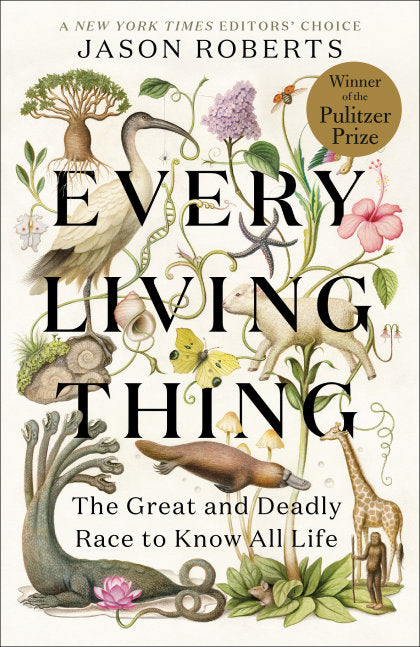
Every Living Thing
Every Living Thing
Couldn't load pickup availability
Collapsible content
ABOUT
“[An] engaging and thought-provoking book, one focused on the theatrical politics and often deeply troubling science that shape our definitions of life on Earth.”—The New York Times
“A fluent and engaging account of the eighteenth-century origins of Darwinism before Darwin.”—The Wall Street Journal
WINNER OF THE PEN/E.O. WILSON LITERARY SCIENCE WRITING AWARD • A KIRKUS REVIEWS BEST BOOK OF THE YEAR
In the eighteenth century, two men—exact contemporaries and polar opposites—dedicated their lives to the same daunting task: identifying and describing all life on Earth. Carl Linnaeus, a pious Swedish doctor with a huckster’s flair, believed that life belonged in tidy, static categories. Georges-Louis de Buffon, an aristocratic polymath and keeper of France’s royal garden, viewed life as a dynamic swirl of complexities. Each began his task believing it to be difficult but not impossible: How could the planet possibly hold more than a few thousand species—or as many could fit on Noah’s Ark?
Both fell far short of their goal, but in the process they articulated starkly divergent views on nature, the future of the Earth, and humanity itself. Linnaeus gave the world such concepts as mammal, primate, and Homo sapiens, but he also denied that species change and he promulgated racist pseudoscience. Buffon formulated early prototypes of evolution and genetics, warned of global climate change, and argued passionately against prejudice. The clash of their conflicting worldviews continued well after their deaths, as their successors contended for dominance in the emerging science that came to be called biology.
In Every Living Thing, Jason Roberts weaves a sweeping, unforgettable narrative spell, exploring the intertwined lives and legacies of Linnaeus and Buffon—as well as the groundbreaking, often fatal adventures of their acolytes—to trace an arc of insight and discovery that extends across three centuries into the present day.
STANDARD, PRIMARY, DM AND VARIANT COVERS
Standard and Primary covers are widely available through general retailers. They often have higher print runs and can be cheaper, especially during sales.
In contrast, Direct Market (DM) and variant covers are primarily sold in comic shops. DM editions tend to have more limited availability and may be more valuable to collectors.
The main differences lie in artwork style, availability, price, and collector appeal. Ultimately, the choice between standard and variant covers depends on personal preference, budget, and individual collecting goals.
PRODUCT TYPES
Comic book enthusiasts have various formats to choose from when collecting their favorite stories.
Here's a brief overview of the main types:
Omnibus
- Large, hardcover collections
- Usually contain complete runs or extensive story arcs
- Typically 800-1000+ pages
- Higher price point, often €100-€150
Oversized Hardcover (OHC)
- Similar dimensions to omnibus, but thinner
- Collect shorter runs or story arcs
- Usually 300-600 pages
- Priced between €30-€50
Hardcover (HC)
- Standard-sized hardcover books
- Collect 6-12 issues typically
- Similar dimensions to single issues, but with a hard cover
- Priced around €25-€35
Trade Paperback (TP)
- Softcover collections
- Standard comic book size
- Usually collect 4-6 issues
- Most affordable option, typically €15-€25
Other Formats
- Absolute Editions: Oversized, deluxe hardcovers (mainly DC Comics)
- Compendiums: Massive paperback collections
- Graphic Novels (OGN/GN): Original stories not previously released as single issues
The choice between these formats often depends on personal preference, budget, and collecting goals. Omnibus and OHC editions offer larger artwork and more content but at a higher price, while TPs provide a more affordable way to collect complete story arcs