

Penguin Publishing Group
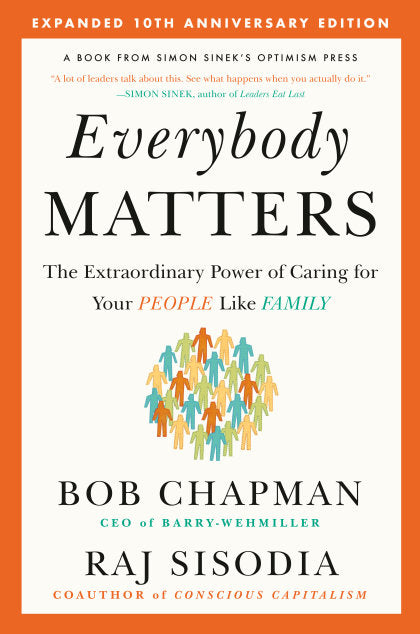
Everybody Matters
Everybody Matters
Couldn't load pickup availability
Collapsible content
ABOUT
“Bob Chapman, CEO of the $1.7 billion manufacturing company Barry-Wehmiller, is on a mission to change the way businesses treat their employees.” – Inc. Magazine
Starting in 1997, Bob Chapman and Barry-Wehmiller have pioneered a dramatically different approach to leadership that creates off-the-charts morale, loyalty, creativity, and business performance. The company utterly rejects the idea that employees are simply functions to be moved around, “managed” with carrots and sticks, or discarded at will. Instead, Barry-Wehmiller manifests the reality that every single person matters, just like in a family. It’s not a cliché on a mission statement; it’s the bedrock of the company’s success.
It’s natural to be skeptical when you first hear about this approach. Every time Barry-Wehmiller acquires a company whose team members have experienced more traditional management practices, the new team members are skeptical too. But they soon learn what it’s like to work at an exceptional company where the goal is for everyone to feel trusted and cared for—and where it’s expected that they will justify that trust by caring for one another and putting the common good first.
Chapman and coauthor Raj Sisodia show how any organization can reject the traumatic consequences of rolling layoffs, dehumanizing rules, and hypercompetitive cultures. In this tenth anniversary update to Everybody Matters, Chapman and Sisodia share new statistics and analysis on the leadership crisis that continues to plague modern businesses and that only Truly Human Leadership—pioneered at Barry-Wehmiller—can fix. Packed with additional insights gained over a decade as the company has evolved, weathered a pandemic, and grown from $1.7 billion in annual revenue with 100 acquisitions to $3.6 billion with more than 140 acquisitions, this updated classic is needed now more than ever.
As Chapman says, “The way we lead impacts the way people live.” Once you stop treating people like functions or costs, disengaged workers begin to share their gifts and talents in service of a shared future. Uninspired workers stop feeling that their jobs have no meaning. Frustrated workers stop taking their bad days out on their spouses and kids. And everyone stops counting the minutes until it’s time to go home. This is the journey documented in Everybody Matters; now it’s time to transform your own workplace.
STANDARD, PRIMARY, DM AND VARIANT COVERS
Standard and Primary covers are widely available through general retailers. They often have higher print runs and can be cheaper, especially during sales.
In contrast, Direct Market (DM) and variant covers are primarily sold in comic shops. DM editions tend to have more limited availability and may be more valuable to collectors.
The main differences lie in artwork style, availability, price, and collector appeal. Ultimately, the choice between standard and variant covers depends on personal preference, budget, and individual collecting goals.
PRODUCT TYPES
Comic book enthusiasts have various formats to choose from when collecting their favorite stories.
Here's a brief overview of the main types:
Omnibus
- Large, hardcover collections
- Usually contain complete runs or extensive story arcs
- Typically 800-1000+ pages
- Higher price point, often €100-€150
Oversized Hardcover (OHC)
- Similar dimensions to omnibus, but thinner
- Collect shorter runs or story arcs
- Usually 300-600 pages
- Priced between €30-€50
Hardcover (HC)
- Standard-sized hardcover books
- Collect 6-12 issues typically
- Similar dimensions to single issues, but with a hard cover
- Priced around €25-€35
Trade Paperback (TP)
- Softcover collections
- Standard comic book size
- Usually collect 4-6 issues
- Most affordable option, typically €15-€25
Other Formats
- Absolute Editions: Oversized, deluxe hardcovers (mainly DC Comics)
- Compendiums: Massive paperback collections
- Graphic Novels (OGN/GN): Original stories not previously released as single issues
The choice between these formats often depends on personal preference, budget, and collecting goals. Omnibus and OHC editions offer larger artwork and more content but at a higher price, while TPs provide a more affordable way to collect complete story arcs