

Penguin Publishing Group
Everybody's Fly
Everybody's Fly
Couldn't load pickup availability
Collapsible content
ABOUT
“Everybody’s Fly could comfortably sit alongside books by Richard Price, Lucy Sante, Tom Wolfe, or Ed McBain, chronicling New York from the mid-1970s to the early 1990s with both vivid, journalistic descriptions and the outsized flair from a person who was at the center of it all.”
—Rolling Stone
“An exuberant recounting of how a culturally omnivorous kid from Brooklyn willed himself into the wider, shinier world—like Moss Hart’s Act One, but with beatboxing and cans of Krylon spray paint.”
—The New Yorker
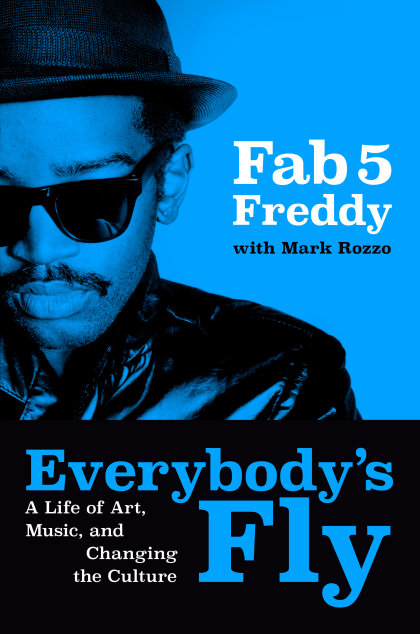
An electrifying memoir from the pioneering cultural icon The New Yorker called “the coolest person in New York,” whose fearless creativity reshaped the worlds of art, music, and style
Fab 5 Freddy doesn’t just have a great story—he is the story. Name a seismic cultural shift, and chances are, he wasn’t just there—he was helping to make it happen. He’s among the first graffiti artists to turn subway tags into fine art, the visionary behind the first hip-hop movie, the bridge between Jean-Michel Basquiat and the downtown new wave scene, the first person to take rap global on MTV, and the opening rhyme of Blondie’s number-one smash hit “Rapture”—“Fab 5 Freddy told me everybody’s fly”—the song that propelled hip-hop from the New York streets to mainstream culture. With a spirit of joyful creativity and a deep capacity for connecting with kindred spirits (Basquiat, Haring, Lee, Flash, Warhol, and the Clash, to name a few), he shattered racial and artistic boundaries, bridging worlds and raising underground movements to pop culture dominance.
Everybody’s Fly is a fast-moving, all-access pass to Fred’s extraordinary life—one that begins in a book- and jazz-filled Brooklyn home and takes us deep into New York’s creative explosions from the 1970s into the 1990s. He didn’t just shape culture, he synthesized it—from highbrow to street, the Bronx to the East Village, punk to rap, Warhol to Wild Style. Whether he’s skipping school to wander New York City’s museums, painting subway cars that became moving masterpieces, or bringing hip-hop to downtown clubs for the first time, Fred’s genius has always been in seeing what others couldn’t—until he made them see it too.
Vibrant, rhapsodic, and compulsively readable, Everybody’s Fly is at once an intimate memoir and panoramic cultural history. It is a love letter to the art of seeing, a fascinating account of an inimitable creative life, and a celebration of what it means to shape culture.
STANDARD, PRIMARY, DM AND VARIANT COVERS
Standard and Primary covers are widely available through general retailers. They often have higher print runs and can be cheaper, especially during sales.
In contrast, Direct Market (DM) and variant covers are primarily sold in comic shops. DM editions tend to have more limited availability and may be more valuable to collectors.
The main differences lie in artwork style, availability, price, and collector appeal. Ultimately, the choice between standard and variant covers depends on personal preference, budget, and individual collecting goals.
PRODUCT TYPES
Comic book enthusiasts have various formats to choose from when collecting their favorite stories.
Here's a brief overview of the main types:
Omnibus
- Large, hardcover collections
- Usually contain complete runs or extensive story arcs
- Typically 800-1000+ pages
- Higher price point, often €100-€150
Oversized Hardcover (OHC)
- Similar dimensions to omnibus, but thinner
- Collect shorter runs or story arcs
- Usually 300-600 pages
- Priced between €30-€50
Hardcover (HC)
- Standard-sized hardcover books
- Collect 6-12 issues typically
- Similar dimensions to single issues, but with a hard cover
- Priced around €25-€35
Trade Paperback (TP)
- Softcover collections
- Standard comic book size
- Usually collect 4-6 issues
- Most affordable option, typically €15-€25
Other Formats
- Absolute Editions: Oversized, deluxe hardcovers (mainly DC Comics)
- Compendiums: Massive paperback collections
- Graphic Novels (OGN/GN): Original stories not previously released as single issues
The choice between these formats often depends on personal preference, budget, and collecting goals. Omnibus and OHC editions offer larger artwork and more content but at a higher price, while TPs provide a more affordable way to collect complete story arcs