

Catapult
Everything Under the Moon
Everything Under the Moon
Couldn't load pickup availability
Collapsible content
ABOUT
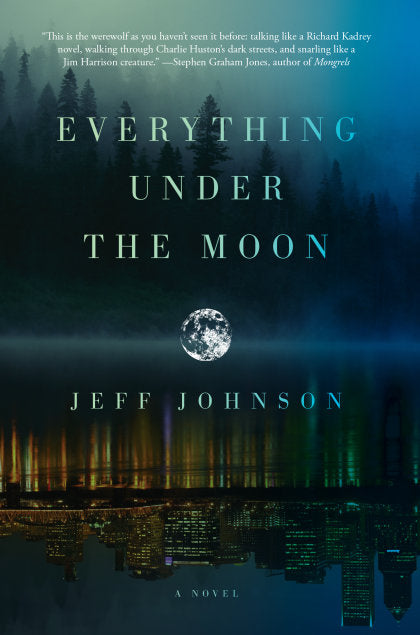
"This is the werewolf as you haven't seen it before: talking like a Richard Kadrey novel, walking through Charlie Huston's dark streets, and snarling like a Jim Harrison creature." —Stephen Graham Jones, author of Mongrels
Born in Missouri more than a century ago and raised in a Pentecostal orphanage, the creature now calling himself Gelson Verber has changed his name countless times. He’s part-werewolf, and makes his living hunting certain kinds of bad men—criminals, rapists, thugs—in an often grotesque parody of the natural order. Verber is clearly suffering from the kinds of things a werewolf would be uniquely vulnerable to in the modern world: the horror of war, drug abuse, and isolation in the rain-drenched environment of Portland, Oregon. He has PTSD, but in a unique way, often flashing back to his time with a regiment in World War II.
His smooth life as a serial killer takes a turn when he falls into the crosshairs of Salt Street, a development corporation running pirated criminology software and Big Data sieves to identify werewolf hybrids, who are then forced into servitude. As he falls deeper into the trap that has been set for him, his introduction to its evil architect triggers within Verber a string of recollections, conversations with the late werewolf-hybrid, John Jack Bridger. Salt Street's trap is masterful, but it does have one terrible flaw: you cannot cage someone—or something—like Gelson Verber.
STANDARD, PRIMARY, DM AND VARIANT COVERS
Standard and Primary covers are widely available through general retailers. They often have higher print runs and can be cheaper, especially during sales.
In contrast, Direct Market (DM) and variant covers are primarily sold in comic shops. DM editions tend to have more limited availability and may be more valuable to collectors.
The main differences lie in artwork style, availability, price, and collector appeal. Ultimately, the choice between standard and variant covers depends on personal preference, budget, and individual collecting goals.
PRODUCT TYPES
Comic book enthusiasts have various formats to choose from when collecting their favorite stories.
Here's a brief overview of the main types:
Omnibus
- Large, hardcover collections
- Usually contain complete runs or extensive story arcs
- Typically 800-1000+ pages
- Higher price point, often €100-€150
Oversized Hardcover (OHC)
- Similar dimensions to omnibus, but thinner
- Collect shorter runs or story arcs
- Usually 300-600 pages
- Priced between €30-€50
Hardcover (HC)
- Standard-sized hardcover books
- Collect 6-12 issues typically
- Similar dimensions to single issues, but with a hard cover
- Priced around €25-€35
Trade Paperback (TP)
- Softcover collections
- Standard comic book size
- Usually collect 4-6 issues
- Most affordable option, typically €15-€25
Other Formats
- Absolute Editions: Oversized, deluxe hardcovers (mainly DC Comics)
- Compendiums: Massive paperback collections
- Graphic Novels (OGN/GN): Original stories not previously released as single issues
The choice between these formats often depends on personal preference, budget, and collecting goals. Omnibus and OHC editions offer larger artwork and more content but at a higher price, while TPs provide a more affordable way to collect complete story arcs