

Knopf Doubleday Publishing Group
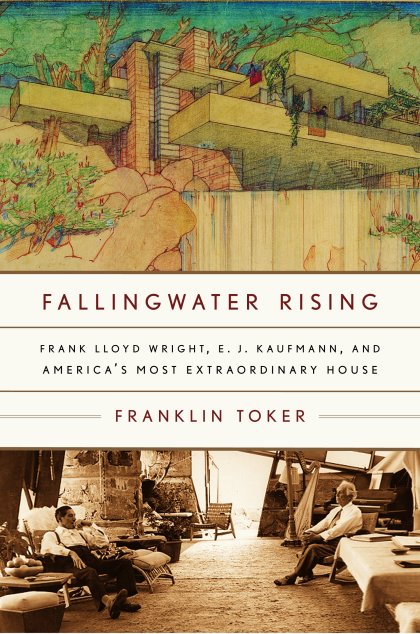
Fallingwater Rising
Fallingwater Rising
Couldn't load pickup availability
Collapsible content
ABOUT
When he got the commission to design the house, Wright was nearing seventy, his youth and his early fame long gone. It was the Depression, and Wright had no work in sight. Into his orbit stepped Edgar J. Kaufmann, a Pittsburgh department-store mogul–“the smartest retailer in America”–and a philanthropist with the burning ambition to build a world-famous work of architecture. It was an unlikely collaboration: the Jewish merchant who had little concern for modern architecture and the brilliant modernist who was leery of Jews. But the two men collaborated to produce an extraordinary building of lasting architectural significance that brought international fame to them both and confirmed Wright’s position as the greatest architect of the twentieth century.
Fallingwater Rising is also an enthralling family drama, involving Kaufmann, his beautiful cousin/wife, Liliane, and their son, Edgar Jr., whose own role in the creation of Fallingwater and its ongoing reputation is central to the story. Involving such key figures of the l930s as Frida Kahlo, Albert Einstein, Henry R. Luce, William Randolph Hearst, Ayn Rand, and Franklin Roosevelt, Fallingwater Rising shows us how E. J. Kaufmann’s house became not just Wright’s masterpiece but a fundamental icon of American life.
One of the pleasures of the book is its rich evocation of the upper-crust society of Pittsburgh–Carnegie, Frick, the Mellons–a society that was socially reactionary but luxury-loving and baronial in its tastes, hobbies, and sexual attitudes (Kaufmann had so many mistresses that his store issued them distinctive charge plates they could use without paying).
Franklin Toker has been studying Fallingwater for eighteen years. No one but he could have given us this compelling saga of the most famous private house in the world and the dramatic personal story of the fascinating people who made and used it.
A major contribution to both architectural and social history.
STANDARD, PRIMARY, DM AND VARIANT COVERS
Standard and Primary covers are widely available through general retailers. They often have higher print runs and can be cheaper, especially during sales.
In contrast, Direct Market (DM) and variant covers are primarily sold in comic shops. DM editions tend to have more limited availability and may be more valuable to collectors.
The main differences lie in artwork style, availability, price, and collector appeal. Ultimately, the choice between standard and variant covers depends on personal preference, budget, and individual collecting goals.
PRODUCT TYPES
Comic book enthusiasts have various formats to choose from when collecting their favorite stories.
Here's a brief overview of the main types:
Omnibus
- Large, hardcover collections
- Usually contain complete runs or extensive story arcs
- Typically 800-1000+ pages
- Higher price point, often €100-€150
Oversized Hardcover (OHC)
- Similar dimensions to omnibus, but thinner
- Collect shorter runs or story arcs
- Usually 300-600 pages
- Priced between €30-€50
Hardcover (HC)
- Standard-sized hardcover books
- Collect 6-12 issues typically
- Similar dimensions to single issues, but with a hard cover
- Priced around €25-€35
Trade Paperback (TP)
- Softcover collections
- Standard comic book size
- Usually collect 4-6 issues
- Most affordable option, typically €15-€25
Other Formats
- Absolute Editions: Oversized, deluxe hardcovers (mainly DC Comics)
- Compendiums: Massive paperback collections
- Graphic Novels (OGN/GN): Original stories not previously released as single issues
The choice between these formats often depends on personal preference, budget, and collecting goals. Omnibus and OHC editions offer larger artwork and more content but at a higher price, while TPs provide a more affordable way to collect complete story arcs