

Beacon Press
Feel the Floor
Feel the Floor
Couldn't load pickup availability
Collapsible content
ABOUT
“What Footer does, and smartly, while winding the 20th century’s pop and socio-culturalism into a neat, critically rhapsodic ball, is remind audiences that Bradley did it all, and did it first.”—Jazz Times
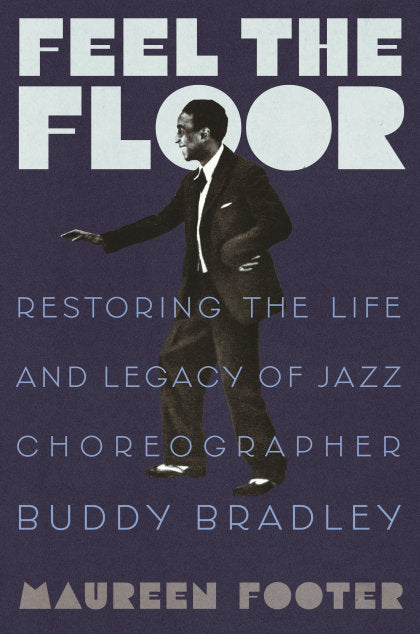
A stunning resurrection of the visionary choreographer Buddy Bradley whose contributions to rhythm tap and jazz dance in the 1920s and ’30s indelibly transformed the way we move to music
In Feel the Floor, Maureen Footer shows how Bradley’s revolutionary moves electrified Broadway in the 1920s and conquered London’s West End in the 1930s, introducing new inflections to the era’s tap and jazz dance.
His experiments in rhythm and staging would anticipate bebop, and his influence even permeated classical dance, cross-pollinating with ballet choreographers like Frederick Ashton and George Balanchine.
Mirroring today’s fight for recognition of Black contributors to transatlantic culture, Buddy Bradley’s story isn’t just one of influence. He created the movement language we still speak today.
The white performers Bradley taught to move became legends: Eleanor Powell, Ruby Keeler, Adele Astaire, Jessie Matthews. Bradley was also the first to fuse movement, character, and narrative in the theater, setting the stage for the integrated book musical and the careers of Agnes de Mille, Bob Fosse, and Jerome Robbins.
In post-war Great Britain, as Black American dancers and jazz musicians flocked to London (and a congenial base at Bradley’s dance school), he danced and choreographed with Baby Laurence, Pete Nugent, Frankie Manning, and Mabel Lee, among others.
Footer spent five years in prodigious research, crossing two continents, tracking ancestral history in the Deep South, and enlisting private investigators to uncover Bradley’s buried legacy.
Feel the Floor corrects the false narratives that have erased Bradley’s influence, revealing how one man’s genius transformed musical theater, shaped modern ballet, and rewired the very DNA of American dance.
STANDARD, PRIMARY, DM AND VARIANT COVERS
Standard and Primary covers are widely available through general retailers. They often have higher print runs and can be cheaper, especially during sales.
In contrast, Direct Market (DM) and variant covers are primarily sold in comic shops. DM editions tend to have more limited availability and may be more valuable to collectors.
The main differences lie in artwork style, availability, price, and collector appeal. Ultimately, the choice between standard and variant covers depends on personal preference, budget, and individual collecting goals.
PRODUCT TYPES
Comic book enthusiasts have various formats to choose from when collecting their favorite stories.
Here's a brief overview of the main types:
Omnibus
- Large, hardcover collections
- Usually contain complete runs or extensive story arcs
- Typically 800-1000+ pages
- Higher price point, often €100-€150
Oversized Hardcover (OHC)
- Similar dimensions to omnibus, but thinner
- Collect shorter runs or story arcs
- Usually 300-600 pages
- Priced between €30-€50
Hardcover (HC)
- Standard-sized hardcover books
- Collect 6-12 issues typically
- Similar dimensions to single issues, but with a hard cover
- Priced around €25-€35
Trade Paperback (TP)
- Softcover collections
- Standard comic book size
- Usually collect 4-6 issues
- Most affordable option, typically €15-€25
Other Formats
- Absolute Editions: Oversized, deluxe hardcovers (mainly DC Comics)
- Compendiums: Massive paperback collections
- Graphic Novels (OGN/GN): Original stories not previously released as single issues
The choice between these formats often depends on personal preference, budget, and collecting goals. Omnibus and OHC editions offer larger artwork and more content but at a higher price, while TPs provide a more affordable way to collect complete story arcs