

Beacon Press
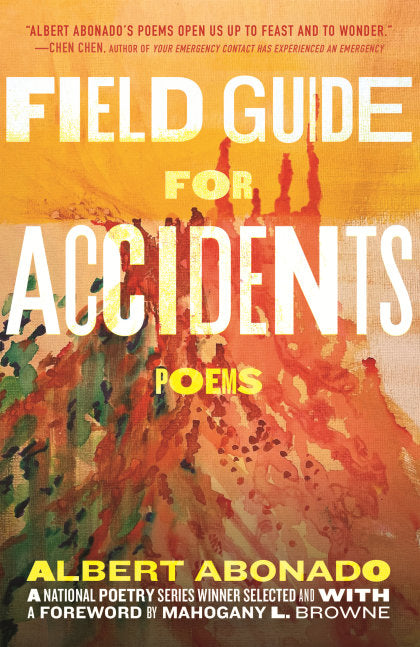
Field Guide for Accidents
Field Guide for Accidents
Couldn't load pickup availability
Collapsible content
ABOUT
An irreverent poetry collection that wrestles with questions of family, mortality, cultural history, and identity from the Filipinx-American experience
"you showed him your teeth, you dared him to look into your mouth to see the metal bands straightening your jaw into an American smile."—from Field Guide for Accidents
Born in the United States to Filipino immigrants, poet Albert Abonado is no stranger to the language of periphery. Neither wholly “American” nor Filipino, Field Guide for Accidents’s speakers are defined by what they are not: not white enough to be born in America, not Asian enough to feel at home in the Philippines. Abonado’s poetry illuminates the strange and surreal in domestic routine, suturing wounds of love, grief, and the contradiction of being Filipinx-American, two identities bound with a hyphen that resists negation. What results is a growing exposure to a world mired in paradox.
The poems in Field Guide for Accidents experiment with the constraints of the poetic line, shaping forms that exhume what tend to haunt us in the silence. In Field Guide for Accidents, memory becomes augmented with the imaginary; suspicion collides with superstition, while spirituality crosses paths with scientific fact. A mother returns to her son as a boat. A stew is prepared with blood yet masked as chocolate. The living eat with the dead in memories built like houses. Mythic, bloodthirsty creatures in Pinoy folklore prey on an exhausted poet. Research conducted in hindsight provides new avenues to explore regret.
For many third-culture kids of the Asian-American diaspora, there is no such thing as a success story for “fitting in.” What matters more is finding where you belong. Spooning images from hand to mouth, the poems in Field Guide for Accidents struggle with what it means to consume and be consumed by American culture.
STANDARD, PRIMARY, DM AND VARIANT COVERS
Standard and Primary covers are widely available through general retailers. They often have higher print runs and can be cheaper, especially during sales.
In contrast, Direct Market (DM) and variant covers are primarily sold in comic shops. DM editions tend to have more limited availability and may be more valuable to collectors.
The main differences lie in artwork style, availability, price, and collector appeal. Ultimately, the choice between standard and variant covers depends on personal preference, budget, and individual collecting goals.
PRODUCT TYPES
Comic book enthusiasts have various formats to choose from when collecting their favorite stories.
Here's a brief overview of the main types:
Omnibus
- Large, hardcover collections
- Usually contain complete runs or extensive story arcs
- Typically 800-1000+ pages
- Higher price point, often €100-€150
Oversized Hardcover (OHC)
- Similar dimensions to omnibus, but thinner
- Collect shorter runs or story arcs
- Usually 300-600 pages
- Priced between €30-€50
Hardcover (HC)
- Standard-sized hardcover books
- Collect 6-12 issues typically
- Similar dimensions to single issues, but with a hard cover
- Priced around €25-€35
Trade Paperback (TP)
- Softcover collections
- Standard comic book size
- Usually collect 4-6 issues
- Most affordable option, typically €15-€25
Other Formats
- Absolute Editions: Oversized, deluxe hardcovers (mainly DC Comics)
- Compendiums: Massive paperback collections
- Graphic Novels (OGN/GN): Original stories not previously released as single issues
The choice between these formats often depends on personal preference, budget, and collecting goals. Omnibus and OHC editions offer larger artwork and more content but at a higher price, while TPs provide a more affordable way to collect complete story arcs