

Knopf Doubleday Publishing Group
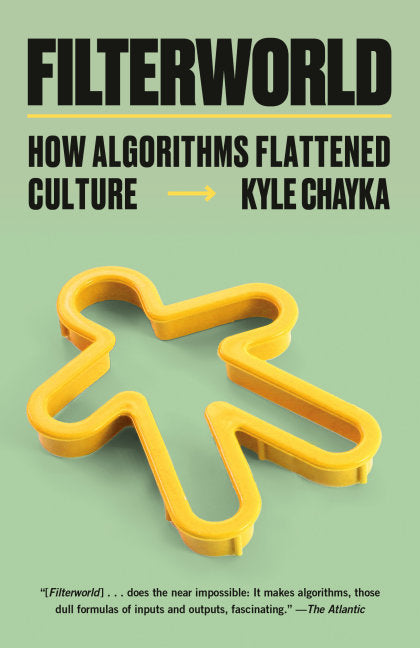
Filterworld
Filterworld
Couldn't load pickup availability
Collapsible content
ABOUT
One of Esquire's 25 Best Nonfiction Books of 2024
“[Filterworld] brings stark clarity to the formulas that guide our behaviors online…it does the near impossible: It makes algorithms, those dull formulas of inputs and outputs, fascinating.”
—The Atlantic
“A thought-provoking account of how Big Tech and its algorithms have rewired interests, degraded language and shaped users to ‘seek out culture that embraces nothingness.’”
—The New York Times Book Review
From trendy restaurants to city grids, to TikTok and Netflix feeds the world round, algorithmic recommendations dictate our experiences and choices. The algorithm is present in the familiar neon signs and exposed brick of Internet cafes, be it in Nairobi or Portland, and the skeletal, modern furniture of Airbnbs in cities big and small. Over the last decade, this network of mathematically determined decisions has taken over, almost unnoticed—informing the songs we listen to, the friends with whom we stay in touch—as we’ve grown increasingly accustomed to our insipid new normal.
This ever-tightening web woven by algorithms is called “Filterworld.” Kyle Chayka shows us how online and offline spaces alike have been engineered for seamless consumption, becoming a source of pervasive anxiety in the process. Users of technology have been forced to contend with data-driven equations that try to anticipate their desires—and often get them wrong. What results is a state of docility that allows tech companies to curtail human experiences—human lives—for profit. But to have our tastes, behaviors, and emotions governed by computers, while convenient, does nothing short of call the very notion of free will into question.
In Filterworld, Chayka traces this creeping, machine-guided curation as it infiltrates the furthest reaches of our digital, physical, and psychological spaces. With algorithms increasingly influencing not just what culture we consume, but what culture is produced, urgent questions arise: What happens when shareability supersedes messiness, innovation, and creativity—the qualities that make us human? What does it mean to make a choice when the options have been so carefully arranged for us? Is personal freedom possible on the Internet?
To the last question, Filterworld argues yes—but to escape Filterworld, and even transcend it, we must first understand it.
STANDARD, PRIMARY, DM AND VARIANT COVERS
Standard and Primary covers are widely available through general retailers. They often have higher print runs and can be cheaper, especially during sales.
In contrast, Direct Market (DM) and variant covers are primarily sold in comic shops. DM editions tend to have more limited availability and may be more valuable to collectors.
The main differences lie in artwork style, availability, price, and collector appeal. Ultimately, the choice between standard and variant covers depends on personal preference, budget, and individual collecting goals.
PRODUCT TYPES
Comic book enthusiasts have various formats to choose from when collecting their favorite stories.
Here's a brief overview of the main types:
Omnibus
- Large, hardcover collections
- Usually contain complete runs or extensive story arcs
- Typically 800-1000+ pages
- Higher price point, often €100-€150
Oversized Hardcover (OHC)
- Similar dimensions to omnibus, but thinner
- Collect shorter runs or story arcs
- Usually 300-600 pages
- Priced between €30-€50
Hardcover (HC)
- Standard-sized hardcover books
- Collect 6-12 issues typically
- Similar dimensions to single issues, but with a hard cover
- Priced around €25-€35
Trade Paperback (TP)
- Softcover collections
- Standard comic book size
- Usually collect 4-6 issues
- Most affordable option, typically €15-€25
Other Formats
- Absolute Editions: Oversized, deluxe hardcovers (mainly DC Comics)
- Compendiums: Massive paperback collections
- Graphic Novels (OGN/GN): Original stories not previously released as single issues
The choice between these formats often depends on personal preference, budget, and collecting goals. Omnibus and OHC editions offer larger artwork and more content but at a higher price, while TPs provide a more affordable way to collect complete story arcs