

Penguin Publishing Group
Forbidden Fruit
Forbidden Fruit
Couldn't load pickup availability
Collapsible content
ABOUT
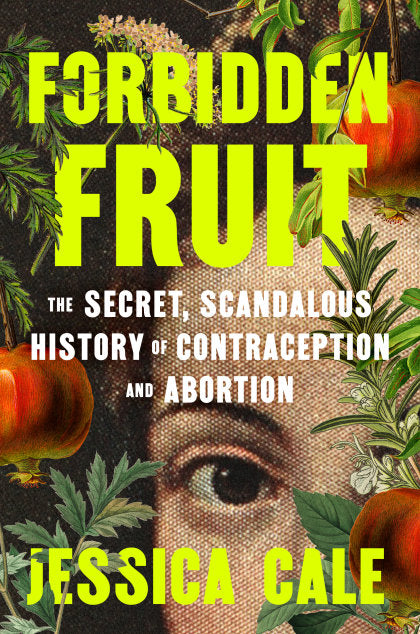
Anti-abortion groups have long used incorrect history to argue against reproductive care, promoting a false nostalgia for a past where women were only housewives and abortion was unthinkable. In truth, says acclaimed historian Jessica Cale, history is filled with courageous women who were not passive pawns, but active agents of change and masters of their sexual destinies—and it’s time their stories were told.
In Forbidden Fruit, Cale sheds light on the state of contraception and abortion pre-Roe v. Wade, unearthing the stories and practices of the real women who lived it—like St. Hildegard von Bingen, a medieval nun who preserved recipes for abortifacients that were used in routine healthcare with the support of the Church; Hannah Woolley, an iconic 17th century Martha Stewart whose cookbooks containing home “remedies” sold out of multiple printings; and Teresia Constantia Phillips, the British courtesan behind the first major internationally serviced condom store in London. Cale’s painstaking research into historical theory, practice, and efficacy covers the surprising history and broader social impact of contraceptive methods such as ancient pessaries, herbal "menstrual regulators," douching, and coitus interruptus, as well as modern methods like the IUD, the Pill, and condoms. Following the story of fertility control from the first civilizations in Ancient Egypt and Mesopotamia to today, she presents a stunning new perspective—that women in past eras had access to contraception and abortion with fewer restrictions and less social stigma than they face in the United States today.
A fascinating history and a timely rallying cry, Forbidden Fruit stresses that, with the future of birth control uncertain, it is more important than ever to understand its past.
STANDARD, PRIMARY, DM AND VARIANT COVERS
Standard and Primary covers are widely available through general retailers. They often have higher print runs and can be cheaper, especially during sales.
In contrast, Direct Market (DM) and variant covers are primarily sold in comic shops. DM editions tend to have more limited availability and may be more valuable to collectors.
The main differences lie in artwork style, availability, price, and collector appeal. Ultimately, the choice between standard and variant covers depends on personal preference, budget, and individual collecting goals.
PRODUCT TYPES
Comic book enthusiasts have various formats to choose from when collecting their favorite stories.
Here's a brief overview of the main types:
Omnibus
- Large, hardcover collections
- Usually contain complete runs or extensive story arcs
- Typically 800-1000+ pages
- Higher price point, often €100-€150
Oversized Hardcover (OHC)
- Similar dimensions to omnibus, but thinner
- Collect shorter runs or story arcs
- Usually 300-600 pages
- Priced between €30-€50
Hardcover (HC)
- Standard-sized hardcover books
- Collect 6-12 issues typically
- Similar dimensions to single issues, but with a hard cover
- Priced around €25-€35
Trade Paperback (TP)
- Softcover collections
- Standard comic book size
- Usually collect 4-6 issues
- Most affordable option, typically €15-€25
Other Formats
- Absolute Editions: Oversized, deluxe hardcovers (mainly DC Comics)
- Compendiums: Massive paperback collections
- Graphic Novels (OGN/GN): Original stories not previously released as single issues
The choice between these formats often depends on personal preference, budget, and collecting goals. Omnibus and OHC editions offer larger artwork and more content but at a higher price, while TPs provide a more affordable way to collect complete story arcs